Volatile essences, volatile markets, volatile jobs, volatile identities: ravintsara in Madagascar (PhD of Chanelle Adams)

October 15, 2025
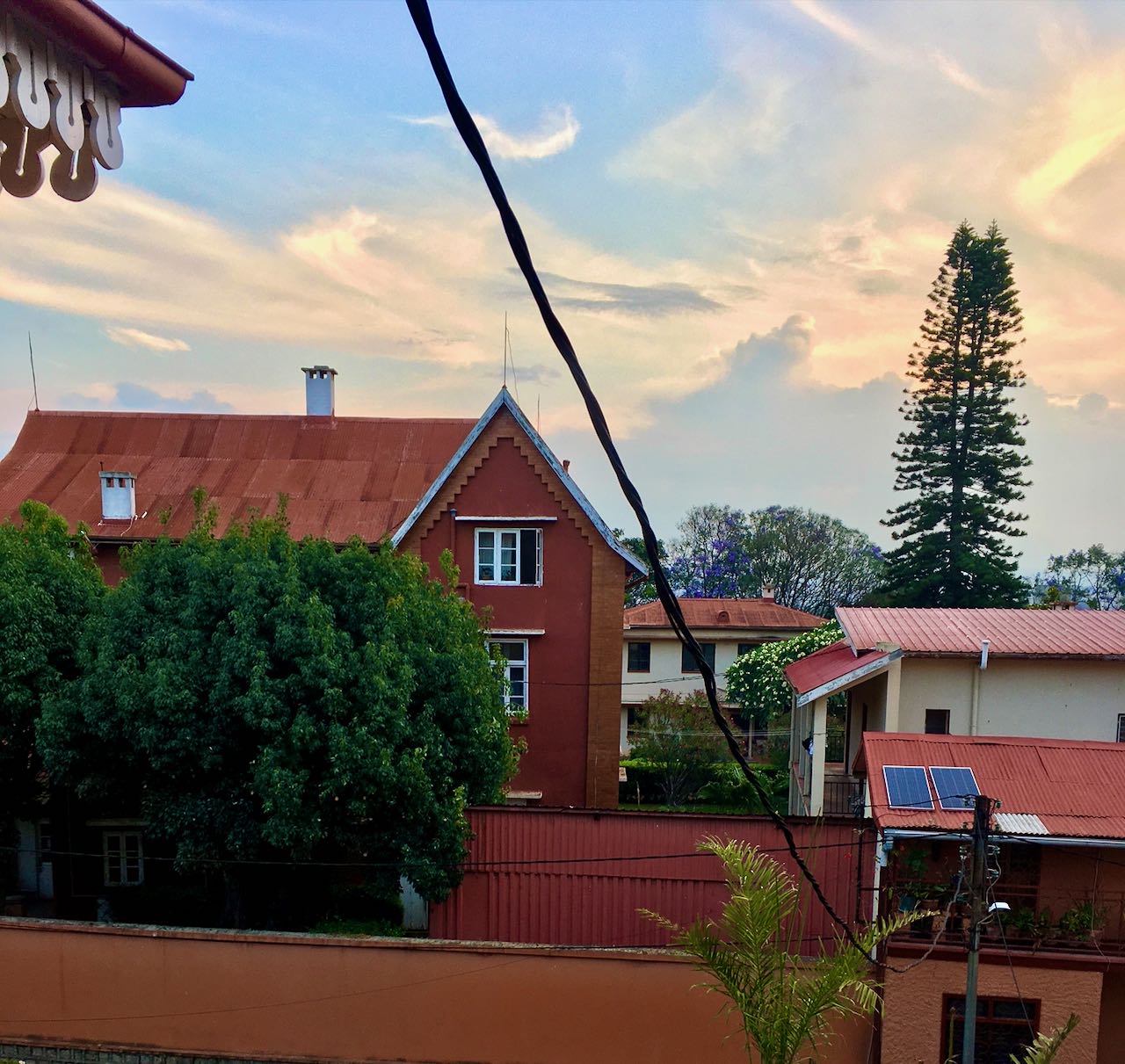
Ornamental ravintsara trees (front left) in Isoraka, Antananarivo, Madagascar (also: jacaranda, aurucaria…). photo: CK 2022.

You know how sometimes a word or thing appears at the margins of your conscience, associated with some value (good, bad, …), but where you really know nothing about it? For me, this describes ravintsara. Long interested in the Malagasy environment, it is perhaps natural that a tree with a name like that would catch my attention (even a beginner in Malagasy will get that it means “good leaf”). While doing research on fire, agrarian change, and highland reforestation, ravintsara crossed my path plenty in the late 1990s and 2000s, but it was never centre stage. I first encountered it knowingly in 2014, when friends showed me some they had planted a few to ornament their land outside Antananarivo, and they were proud to have something native and not pine or eucalyptus. But strangely, its name was already there in a list of 1000s of plants in an inventory of introduced species in Madagascar that colleagues and I put together. And then since moving to Europe I started noticing ravintsara in the essential oils section of French pharmacies.

Chanelle Adam’s PhD, just defended, shows there is history and reason behind my encounters and confusions. It turns out that the botanical and chemical identity of the tree has only been established for three decades or so. Ravintsara was indeed introduced to Madagascar, probably in the 19th century (it is better known elsewhere as the camphor laurel, Camphora officinarum, source of camphor oil). And yet… the variety growing in Madagascar turns out to be a chemotype specific to Madagascar called 1,8-cineole, which is low in camphor oil and high in cineole (also found in eucalypts, rosemary, and bay leaves). To confuse matters further, the endemic tree Cryptocarya agathophylla (also used for essential oils) was previously called ravensara (though not by locals) and confusion between two persists. As environmental programs proliferated on the island in the 1990s and 2000s, the search was on for local trees to reforest the island, and ravensara/ravintsara was a prime candidate (hence my encounter on my friends’ plot in the peripheries of Tana). And with development programs entering the 2000s looking for “win-win” solutions for both environment and livelihoods, essential oil distillation was widely promoted – especially as local distillers and scientists (perhaps benefitting from long-term French investments and know-how in the fragrance, oil, and pharmaceutical arena) had set the groundwork in previous decades, themselves building on and branching from colonial era industries (ylang-ylang, cloves, vanilla…). Hence the little ravintsara bottles in French pharmacies. This all leads up to the opening scene of Chanelle’s thesis, the time when during the height of the Covid 19 crisis the just-deposed President of Madagascar himself claimed to have a cure for the coronavirus – a concoction based in part on ravintsara. And that’s a story that Chanelle tells much better than me!

Read the rest of this entry »

Knowledge gaps and narrative traps in Madagascar’s environmental history

July 1, 2025
Onilahy River, southwest Madagascar

Madagascar’s environmental past is more complex and regionally diverse than the tired narrative of a once-forested island devastated by people would have us believe. In a just-published opinion piece led by one of my academic heroines, Alison Richard, we unpack this oversimplified story, showing how diverse landscapes—from ancient grasslands to dynamic forest mosaics—shifted over millennia, shaped by both natural forces and human action. Yet traces of that older narrative linger stubbornly in scientific debates and conservation strategies. Escaping this narrative trap requires paying closer attention to the deep-time environmental record and to the heterogeneity of human histories across the island.

Read the rest of this entry »

Wildfires coming to Switzerland

June 27, 2025
Forest fire above Rolle, VD, a terrifying vision of the future?

What if, one unusually hot summer, after four weeks without rain, a wildfire progressed across the face of the Jura, the hills of la Côte, or the forested foothills of the Alpes Vaudoises, a spectacle above the Lake Léman. Perhaps sparked by a faulty power line, a spilled charcoal grill with cervelas sausages, an arsonist… First blowing one way with the westerlies, then dangerously confounding firefighters with a switch to a strong clear-skied northeasterly la bise wind…

Read the rest of this entry »

The place of people in restoring nature

April 14, 2025

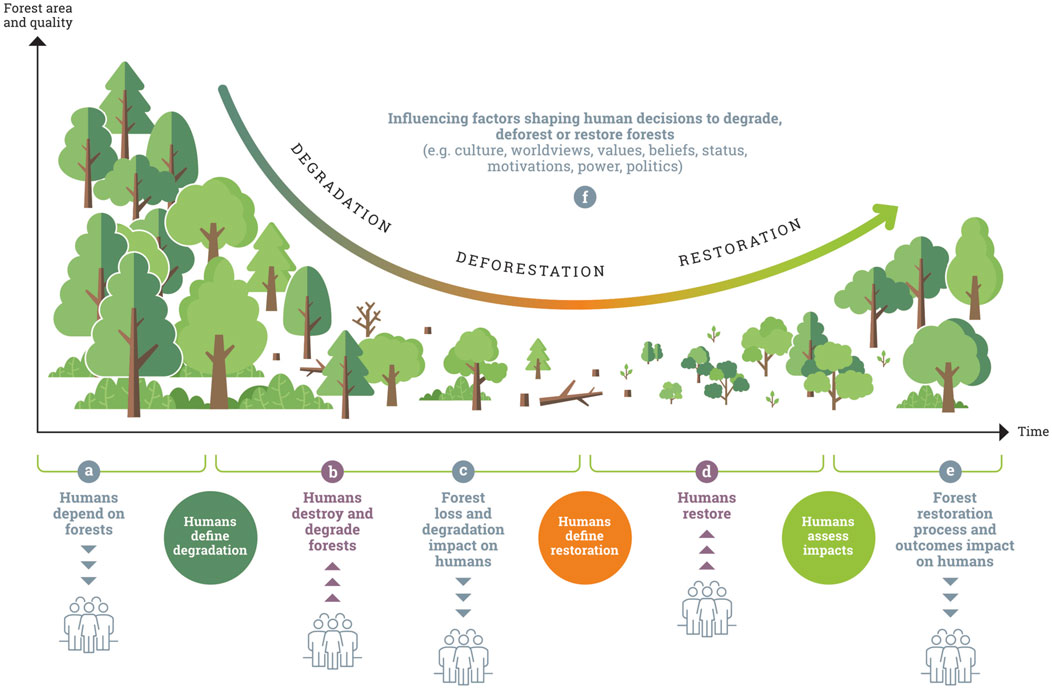
All too often, efforts to restore forests and ecosystems treat the human dimensions as an afterthought. Biodiversity, or carbon offset payments, tend to come first. Yet ultimately, it is people who shape the need for, take decisions on, carry out, and are impacted by restoration. In a pair of short policy perspective articles led by my colleague Stephanie Mansourian, we outline the importance and relevance of human dimensions. The first one presents a five-pillar framework – stretching across scales from local to global – to help policymakers and practitioners think through the diverse places where a human focus is crucial. The second one uses the forest transition curve to illustrate how people are relevant at every stage of forest loss and potential recovery.

Fig 1 from Mansourian et al. 2025b: A simplified forest transition curve from deforestation to reforestation showing the human dimensions at each stage.
Read the rest of this entry »

Global carbon markets or local residents: forest restoration for whom?

January 6, 2025

Seems like everybody is planting trees or restoring forestlands these days. The emphasis is often on carbon capture to attenuate climate change. But this emphasis on carbon offsets (and the money behind it) draws in powerful global actors and carbon market intermediaries. Meanwhile, the costs of forest restoration are all too often unjustly borne by less powerful, local people living in places where trees are planted or restored. How forest restoration efforts be governed so that benefits can accrue at all spatial scales, from global to local?

Read the rest of this entry »

Turkey, Peru, India: confused geographies in a bird name

November 30, 2024
Turkey in Wyoming (photo: Arthur Kull)

Time for a light post as America celebrates Thanksgiving weekend. On the menu, a roasted Meleagris gallopavo domesticus, a fowl native to Mexico and southern USA. But why, oh why, is this bird called “turkey” in English, “peru” in Portuguese, and “of india” in many other languages (“dinde” in French, “indyushka” in Russian, and “hindi” in – hold your hats – Turkish)? How geographically confused can we be? Do names of plants and animals reflect histories of migration and movement, or mistaken identities, or accidental out-of-context snapshots?

Read the rest of this entry »

The dilemma of caring for and doing research for severe sufferers of ME/CFS

October 7, 2024

Ok this isn’t a geography topic but it concerns this geographer’s son. I have written an essay about the absolutely frustrating, paralysing, and paradoxical challenges of caring for someone suffering from very severe ME/CFS (myalgic encephalomyelitis / chronic fatigue syndrome), someone who is stuck in bed all day, sensitive to lights and sounds, with symptoms potentially worsening after any mental or physical exertion (including a doctor’s visit). My essay also touches on the challenges of doing research for cures and treatments – well illustrated just the other day when a study of a new drug for Long-Covid was abandoned at the University of Basel because not enough patients had the energy to come to the hospital five times for the necessary tests and follow-up (1, 2). To summarize: severe ME/CFS and Long Covid patients are too sick to be helped, and help makes things worse. Help! But don’t! What a paradox. I use the metaphor of Schrödinger’s cat to frame the essay, which was just published here on the HealthRising website, as part of Cort Johnson’s article on severe ME/CFS. I reproduce my essay below.

Read the rest of this entry »

Power dynamics in trans-disciplinary research: bashing square pegs into round holes?

July 4, 2024

There is a lot to be said for research that builds on lessons from many academic disciplines and between scientists and practitioners.  But in such research one always has to negotiate power relations.  Whose vision dominates, who compromises?  Who gets more of the funding?  Which framework is used?

Read the rest of this entry »

I am a geographer

June 3, 2024

Stephen Legg, a former colleague from my days at Monash University, asked me for 600 word statement titled “I am a geographer” for the magazine of the Geography Teacher’s Association of Victoria. It was a fun occasion to reflect. See below.

Read the rest of this entry »

Why forest transitions aren’t always sustainable: nine pitfalls

May 22, 2024

Stopping and reversing deforestation is a foremost priority in much of the tropics. Numerous policies and programs try to stem forest clearance, encourage tree planting, and restore forest landscapes. The hope is to promote “forest transitions” similar to the historical turnaround in forest cover trajectories in wealthy temperate countries. Such efforts have become all the more urgent given the climate and biodiversity crises. Yet it is often assumed that more forests is better and more sustainable, without careful consideration of how and where it happens, who wins and who loses, and what kinds of forests. In a recent open access paper, we identify nine pitfalls to such assumptions. Hopefully this inspires researchers, policymakers, and leaders to promote more diverse transitions to sustainable forest use and management.

The nine pitfalls and their implications for research and policy. (Figure 2 from our paper in the journal Environmental Conservation). With photos of forest landscapes across Southeast Asia: (a) plantations of rubber and acacia spreading in central Vietnam with remnant natural forest on hilltops; (b) ancestral lands of Pala’wan farmers on Palawan, Philippines; (c) announcement of an application for a communal land title for heritage land that has already been converted to oil palm plantations in Sabah, Malaysia; and (d) paddy rice fields and upland forest with swidden in Hsipaw, Myanmar. Photos (a) Tran Nam Thang, (b) Wolfram Dressler, (c) Jennifer Bartmess, (d) Kevin Woods.
Read the rest of this entry »