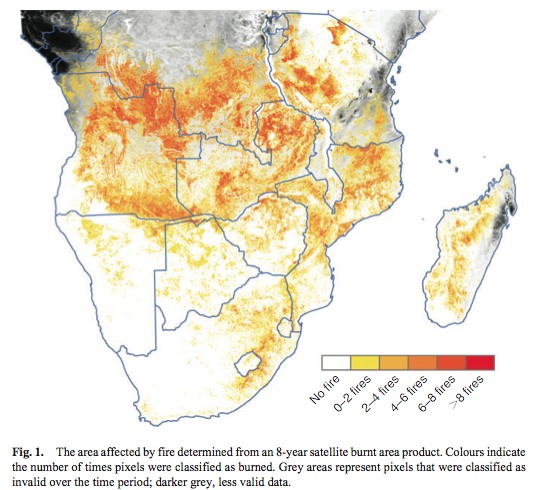
The prehistoric dynamics of fire, vegetation, and humans in Madagascar are still not resolved, though one might get a different impression from the simplified narrative told to galvanise conservation action. Clearly, humans visited, hunted, and eventually settled the island over the last several thousand years, and lit the vegetation on fire throughout. But what kinds of fire, in what kind of vegetation, how often, and with what impact? Charcoal and pollen in lake sediment cores and archaeological digs have informed most of our recent scientific understandings of fire history on the island. Perhaps further answers and hypotheses can be found from innovative botanical, remote sensing, and modelling research being done in Africa. Most striking perhaps – in the face of all the alarmist discourse about the menace des feux de brousse in Madagascar – is how unimpressive Madagascar’s fires appear in any remote sensing image that includes neighbouring Africa (this one is taken from Archibald et al. 2010 in the International Journal of Wildland Fire).


 Posted by christiankull
 Christian Kull