The political ecology of ecosystem services

March 31, 2015

In just the span of a decade or two, it seems that nearly all environmental management writing (whether scientific reports, public awareness brochures, or policy briefs) has come to call on the notion of “ecosystem services” to defend the importance of healthy, functioning “natural” systems. What is this concept, where does it come from, what does it mean, and what doors does it open or close?

Is “ecosystem services” the ultimate win-win idea that translates abstract values of a healthy environment into policy-relevant and policy-actionable chunks? Does it allow ecologists and economists to speak the same language, leading to better outcomes for the environment and for the rural (often marginalised) people who manage it? Or is it a tool of the “neoliberalization” of nature, another means by which capitalism penetrates into new terrains, creating new forms of accumulation in the hands of a global elite, further marginalising the poor? Or is it all of this – and more – at the same time?

Read the rest of this entry »


Approaching invasive species in Madagascar

March 13, 2015

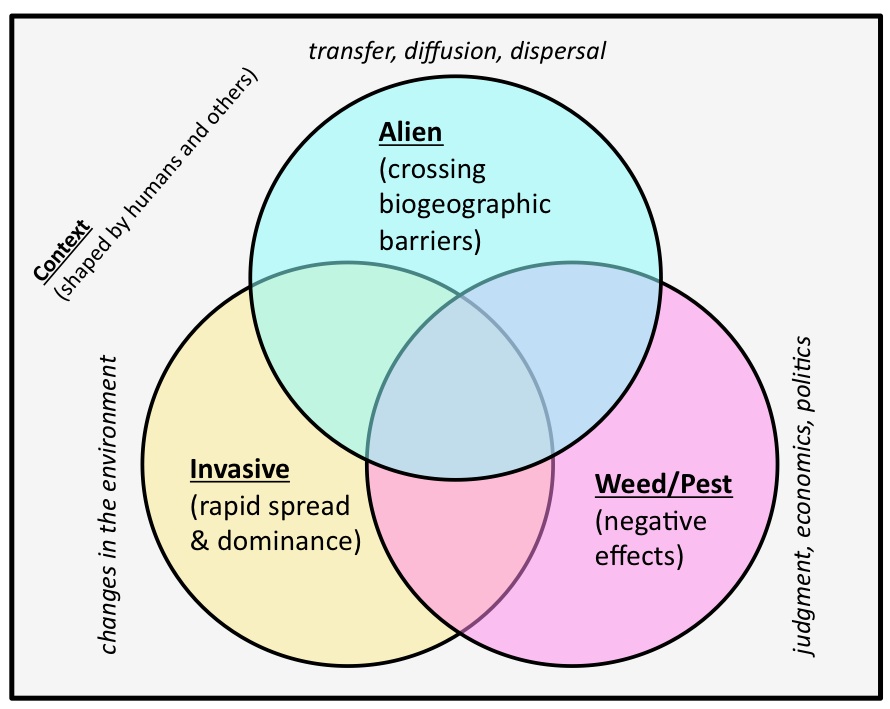
While a number of plants, animals, and insects in Madagascar have been called ’invasive’, the topic of invasive species has until recently received less attention here than in other island contexts. Some species, often alien to Madagascar and introduced by humans, have expanded their range rapidly and have had both negative and positive effects on landscapes, on native biodiversity, and on livelihoods. Examples include the prickly pear (raketa), the silver wattle (mimosa), and, recently, the Asian common toad (radaka boka). Building on a conceptual approach, my recent paper (link; pdf) in the journal Madagascar Conservation and Development emphasizes the importance of inclusive and deliberative site- and population- specific management of invasive species. The paper analyses three separate concepts commonly used in definitions of invasion: the origin, behaviour, and effects of particular species.

The three components often used in defining invasive species. Different definitions emphasise different components.  Source:  Kull et al. 2014 (supplementary online material)

The three components often used in defining invasive species. Different definitions emphasise different components. Source: Kull et al. 2014 (supplementary online material)

It places these concepts in their broader social and ecological context, with particular attention to local perspectives on invasive species. My co-authors and I illustrate these concepts with numerous Malagasy examples from the literature and our own experiences. Read the rest of this entry »