Stopping and reversing deforestation is a foremost priority in much of the tropics. Numerous policies and programs try to stem forest clearance, encourage tree planting, and restore forest landscapes. The hope is to promote “forest transitions” similar to the historical turnaround in forest cover trajectories in wealthy temperate countries. Such efforts have become all the more urgent given the climate and biodiversity crises. Yet it is often assumed that more forests is better and more sustainable, without careful consideration of how and where it happens, who wins and who loses, and what kinds of forests. In a recent open access paper, we identify nine pitfalls to such assumptions. Hopefully this inspires researchers, policymakers, and leaders to promote more diverse transitions to sustainable forest use and management.

I find the sixth pitfall particularly important: that the forest transition concept tends to divert attention from the simplification of forestlands. The incredible surge of policy efforts to stop deforestation, plant trees, and restore forests is not just a matter of making a U-shaped curve in forest cover; in our southeast Asia case studies it is also leading to a transformation in the socio-ecological character of forest. What used to be a diversity of “lived forests”, actively managed by local people as swidden lands, forest product harvesting zones, hunting grounds, and ancestral territory, are increasingly recategorised and reframed into two simple categories: “conservation forests” (where locals are largely kept out) and “production forests” (increasingly organised around economic goals, increasingly industrial monoculture tree crops). Local people lose control to the state, international, and economic actors. This concept was developed by Nguyen Thi Hai Van in her thesis, calling it a “bifurcation” of forest uses.
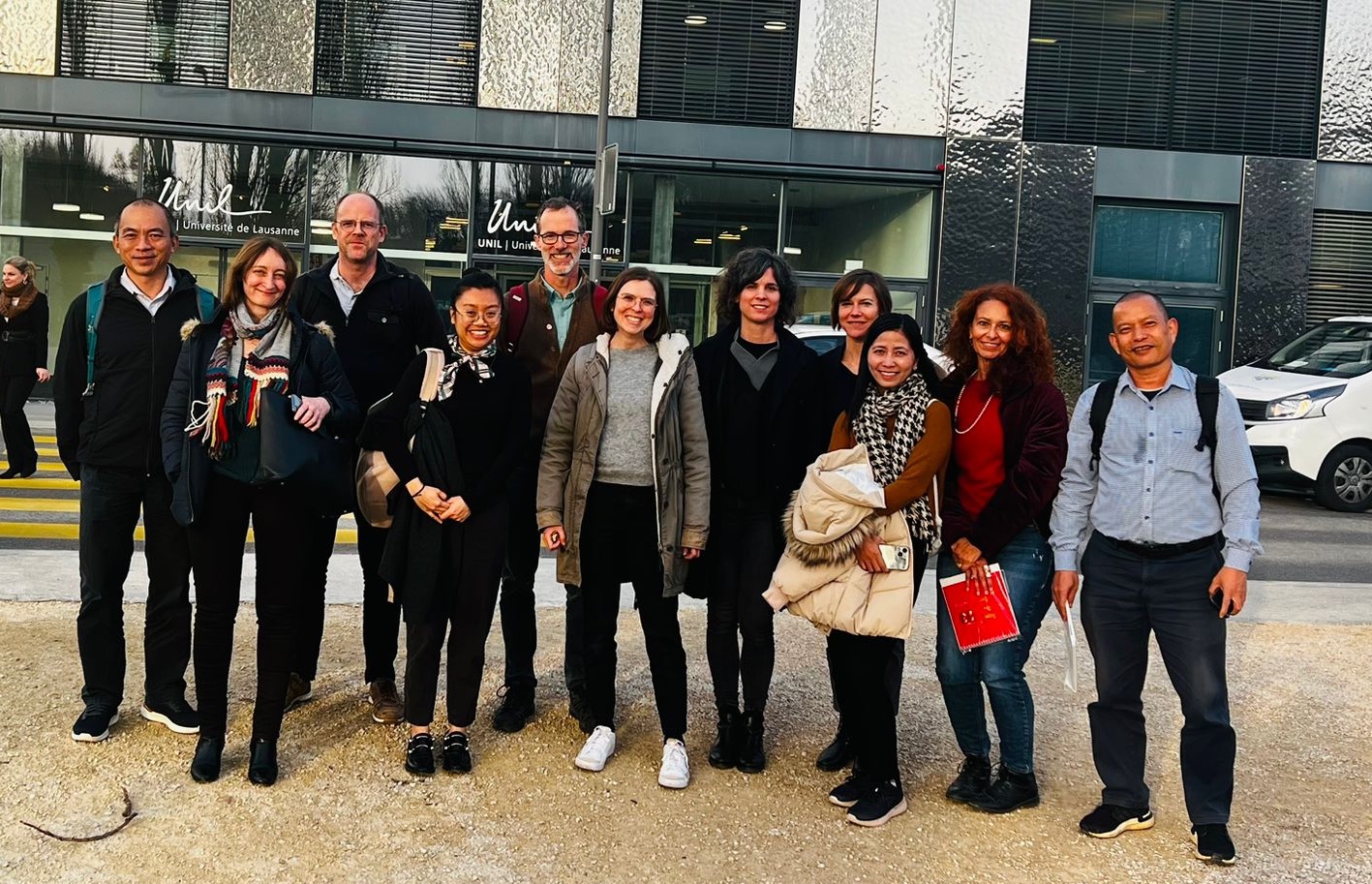
The paper is a capstone output from the FT Viet project funded by the R4D program (Swiss Programme for Research on Global Issues for Development). The ideas in it were developed at a fantastic workshop we hosted in Lausanne in early 2023, through the excellent organisational efforts of Nguyen Thi Hai Van.
Citation: Kull, Christian A., Jennifer Bartmess, Wolfram Dressler, Simone Gingrich, Maciej Grodzicki, Katarzyna Jasikowska, Zofia Łapniewska, Stephanie Mansourian, Van Thi Hai Nguyen, Joel Persson, Melanie Pichler, Herimino Manoa Rajaonarivelo, Amélie Robert, Thang Nam Tran & Kevin Woods (2024) Pitfalls for the sustainability of forest transitions: evidence from Southeast Asia. Environmental Conservation 51 (3):pp. https://doi.org/10.1017/S0376892924000079

 Christian Kull