Seems like everybody is planting trees or restoring forestlands these days. The emphasis is often on carbon capture to attenuate climate change. But this emphasis on carbon offsets (and the money behind it) draws in powerful global actors and carbon market intermediaries. Meanwhile, the costs of forest restoration are all too often unjustly borne by less powerful, local people living in places where trees are planted or restored. How forest restoration efforts be governed so that benefits can accrue at all spatial scales, from global to local?
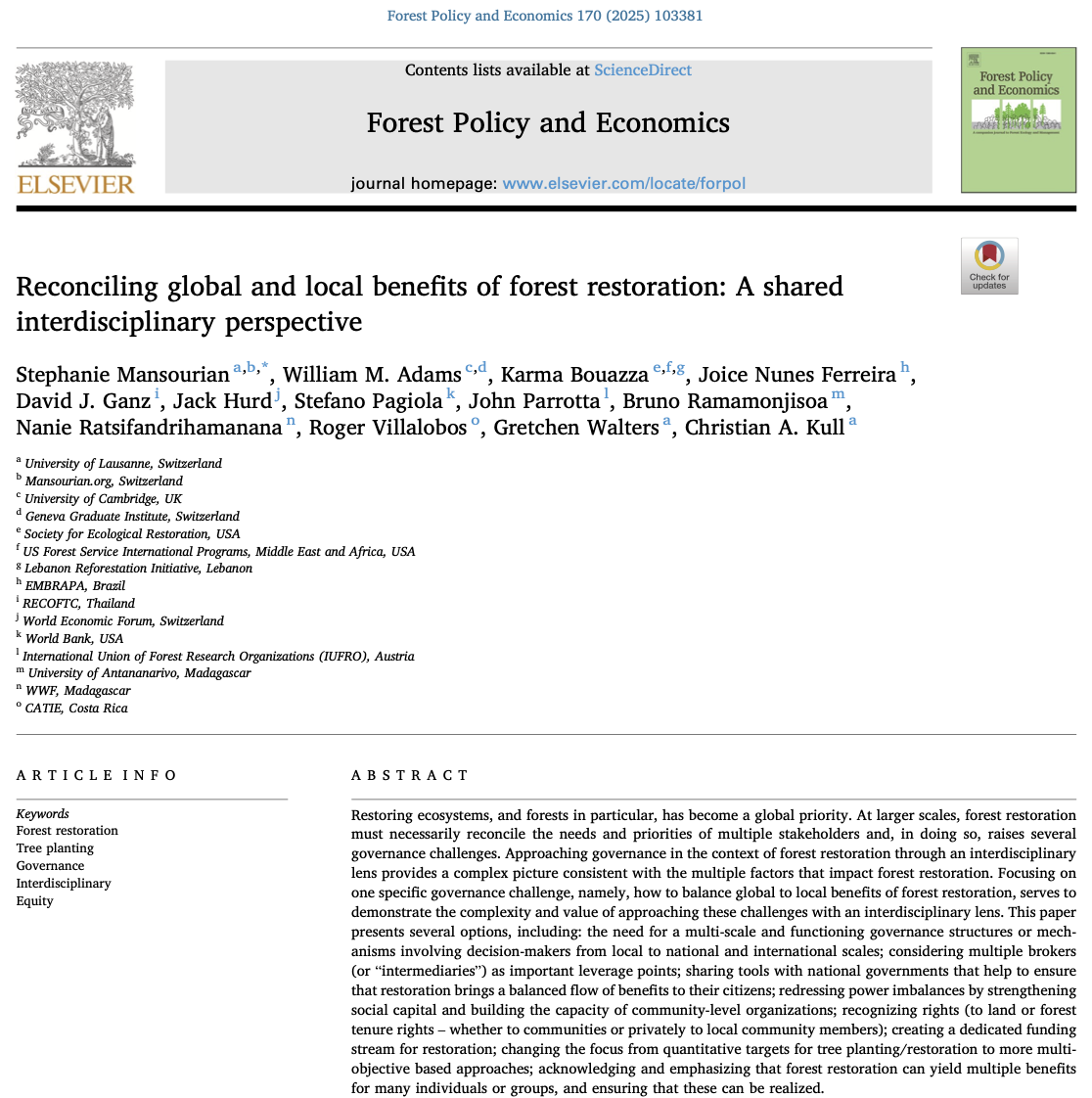
An interdisciplinary panel of experts proposes answers to this question, in a short article recently published in Forest Policy and Economics (free access here until Feb8)(authors version pdf). We suggest three main directions. First, decision-making structures must effectively incorporate different scales. This can be done through recognising national governments as critical actors, addressing tree-panting intermediaries (like Ecosia, One Tree Planted, and others) as key leverage points, all while encouraging multi-scale governance structures. Second, power imbalances between local and global actors need redressing, through dedicated funding, recognition of rights, and building capacity. And third, moving beyond simple quantitative targets of trees planted or carbon sequestered to broader, more diverse targets that include the diverse benefits of restoration to different people. The details and examples are in the paper.
This paper emerges from a project I lead with Stephanie Mansourian entitled “The governance of tree planting and forest restoration: whose decisions, what norms and what outcomes?”, and funded by the Velux Stiftung (yes, the skylight/roof window folks). We aim to improve integration of governance dimensions in forest restoration implementation, and to contribute to improving local implementation of global targets on tree planting and restoration. The project has three main components: (1) a systematic, global review of challenges and solutions to how people organise, make decisions, regulate, and implement tree planting and forest restoration interventions; (2) PhD projects at the University of Antananarivo (Madagascar) on two specific governance challenges – land tenure and stakeholder dynamics; (3) a high level, international research-practice interdisciplinary expert group – the co-authors of the article described above – as a sort of think-tank for these questions and ‘ambassadors’ for the project.

 Christian Kull
Why are the costs of forest restoration often unjustly borne by local communities? Regard Akuntansi