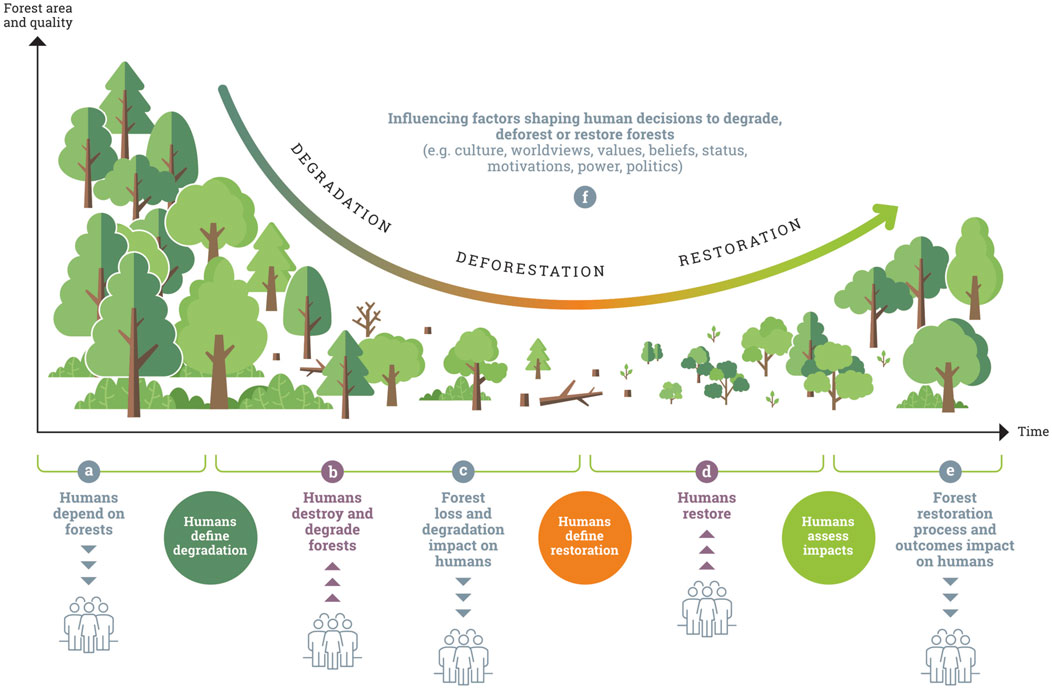
All too often, efforts to restore forests and ecosystems treat the human dimensions as an afterthought. Biodiversity, or carbon offset payments, tend to come first. Yet ultimately, it is people who shape the need for, take decisions on, carry out, and are impacted by restoration. In a pair of short policy perspective articles led by my colleague Stephanie Mansourian, we outline the importance and relevance of human dimensions. The first one presents a five-pillar framework – stretching across scales from local to global – to help policymakers and practitioners think through the diverse places where a human focus is crucial. The second one uses the forest transition curve to illustrate how people are relevant at every stage of forest loss and potential recovery.
References:
- Mansourian, S, INS Djenontin, M Elias, JA Oldekop, MAA Derkyi, CA Kull & P Pacheco (2025a) Ecosystem restoration centered in people. Restoration Ecology: e70049. dx.doi.org/10.1111/rec.70049. (preprint pdf)
- Mansourian, S, INS Djenontin, M Elias, JA Oldekop, MAA Derkyi, CA Kull & P Pacheco (2025b) Situating the “human” in forest landscape restoration. Frontiers in Environmental Science 12. dx.doi.org/10.3389/fenvs.2024.1522979.
Our participation in these publications made possible by our Velux Stiftung grant. The rest of the author team worked on this project a long time before I joined; their first amazing output was a 2024 joint report with IUFRO, WWF, SER, and UNIL entitled Human Dimensions of Forest Landscape Restoration.
 Christian Kull