
What if, one unusually hot summer, after four weeks without rain, a wildfire progressed across the face of the Jura, the hills of la Côte, or the forested foothills of the Alpes Vaudoises, a spectacle above the Lake Léman. Perhaps sparked by a faulty power line, a spilled charcoal grill with cervelas sausages, an arsonist… First blowing one way with the westerlies, then dangerously confounding firefighters with a switch to a strong clear-skied northeasterly la bise wind…
As a scholar of fires in Madagascar, and former resident of fire-prone Melbourne, Berkeley, and Boulder, this nightmare scenario has crossed my mind, Which is why I jumped at a chance to attend a recent workshop organised by the Forum Forestier Lémanique on forest fires in the Lake Geneva region. Participants – foresters, environmental managers, emergency services, and more – came from institutions on both side of the border: France (ONF, Haute-Savoie, …) and Switzerland (cantons Geneva, Vaud, Valais, OFEV, …).
Here are my main observations on what I heard in the workshop, through the prism of an outsider having worked in places where fire is more common:
First, official awareness. In both countries, there has been a major awakening in past 5 years that, due to climate change, they had better be ready for fire in places where fire has historically been scarce. This is an excellent development. In France, fire preparedness rules apply to the whole country since 2021 (instead of just to the fire-prone south), including obligations for landowners to clear brush, for instance. In Vaud (Switzerland), since 2022 there are weekly fire danger meetings by cantonal agencies during the fire season, and a significant effort in making vulnerability and danger maps, and drafting local preparedness plans (for instance, for the pine forests near the campground in La Sarraz). The Federal Office for the Environment now has a national forest fire danger map.
Second, a focus on suppression. I was surprised at the extent to which the entire apparatus is 100% focused on fire as a threat and on stopping (almost all) fires. By apparatus I mean the institutions, the jobs people have, the discourses, the presentation slides, the financing…. Once you start setting a goal of stopping all fires, there is always more you can do, more money to spend. The French even have a policy of controlling fires within the first 15-30 minutes (that reminded me of the historical 9am rule of the US Forest Service).
Any fire scholar will tell you that pure suppression may be a double-edged sword. And that in the pre-industrial era, farmers and herders used lots more small-scale fires, which have now disappeared, with consequences for fuel load and structure. One speaker did allude to this – that lots of small fires, some escaped, in the historical period were now replaced by the occasional big wildfire – but there was no reflexivity about this. Another speaker briefly did put up a graph of wildfires in the USA (showing how suppression success eventually was followed by worse fires) but that passed uncommented and quickly onto the devastation of the January Los Angeles wildfires and people displaced by wildfires.
University of Bern fire scholar Christine Eriksen made a very astute observation when I reported to her about this event: “I’m glad they’re taking wildfire seriously but it’s a one-sided fascination they are nurturing: the adrenaline of putting out fires, not the slow care required to coexist with fire“.
Third, public as a threat. It was also surprising to me how in the tone of discussions ‘the public’ was largely equated with ‘a threat’. Indeed, poorly managed campfires and sausage sizzles are dangerous ignition sources. But the framing of people in a rather flat, one-sided way as a threat, and discussions of rules and restrictions (when and where campfires can be made, for instance) occupied a rather large part of time and attention in the day’s discussions. Even when foresters discussed building more access roads to enable fire breaks and fire fighting, this was considered as possibly more negative than positive as it would bring more people and bikers into the forest.
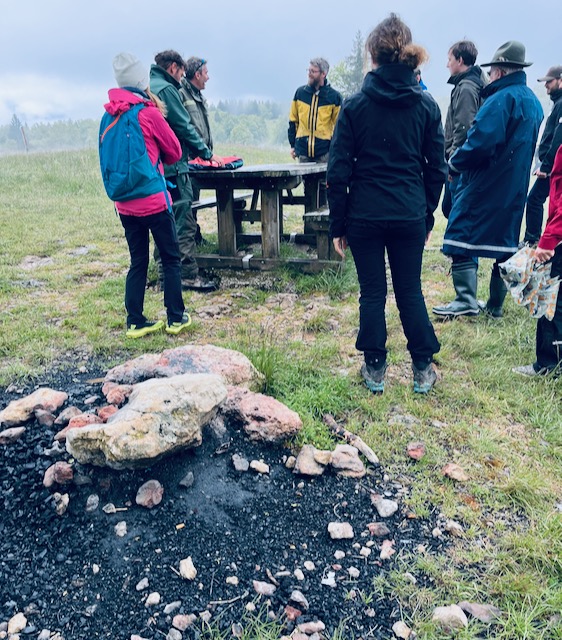
Finally, two stand-out images. Aside from the incongruous image of workshop participants shivering in the rainy fog observing burnt picnic spots on the Salève, two images stood out for me from the day:
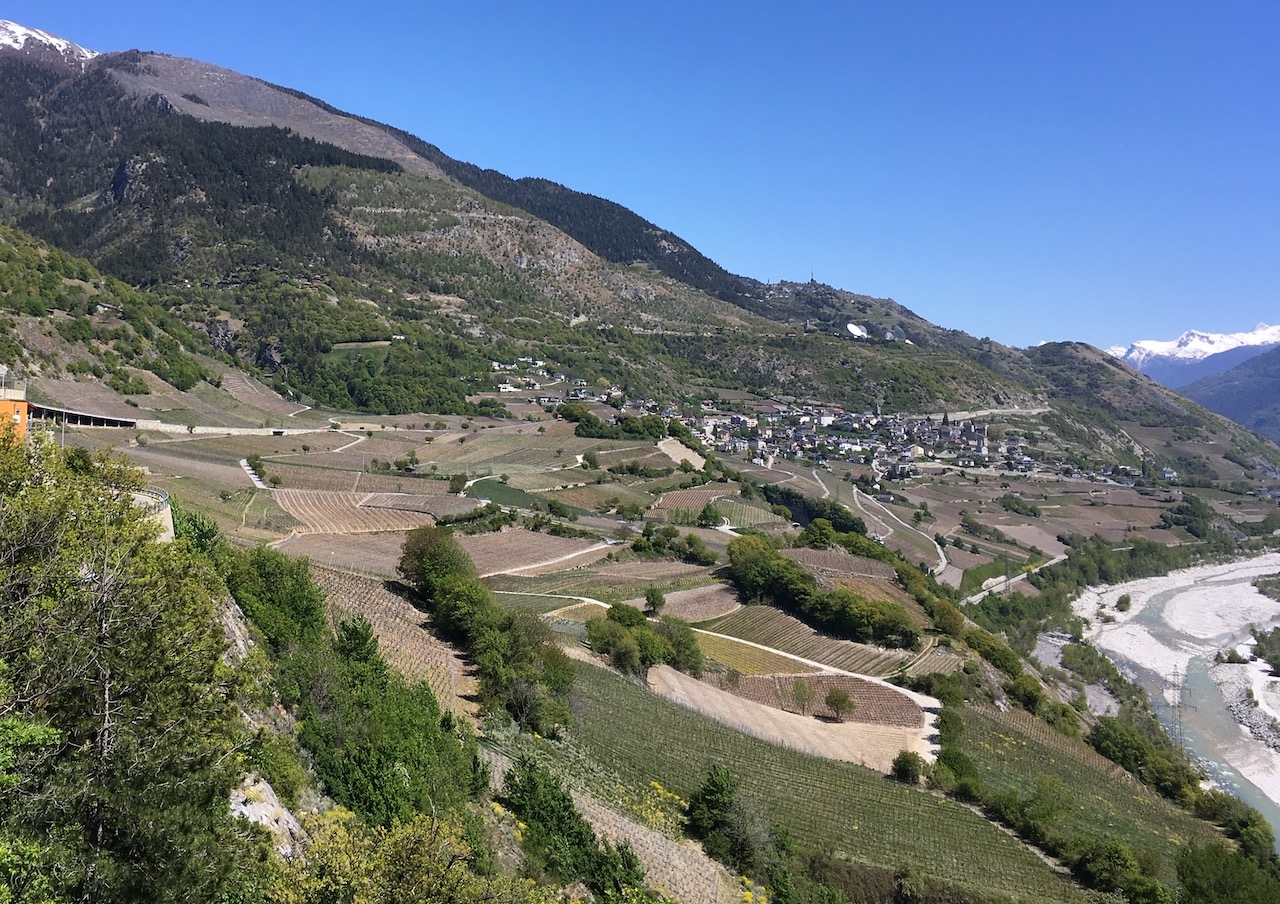
First, a forester from the Valais presented an unforgettable time series of wildlife camera images before, during, and after the Bitsch/Riederhorn fire of 2023. The photos showed not only the smoke and flames, but also recorded the wicked temperature spike as the fire front passed. This goes to show that – at least in the inner-Alpine valley of the upper Rhône River, large wildfires are not just a hypothetical future. Fires are already here. The 185 hectare Bitsch/Riederhorn fire of 2023 was preceded by major conflagrations above Leuk (2003) and Visp (2011). I don’t have those wildlife cam photos, but instead, here’s a photo gallery of two of the recovering fire scars covering entire mountainsides.

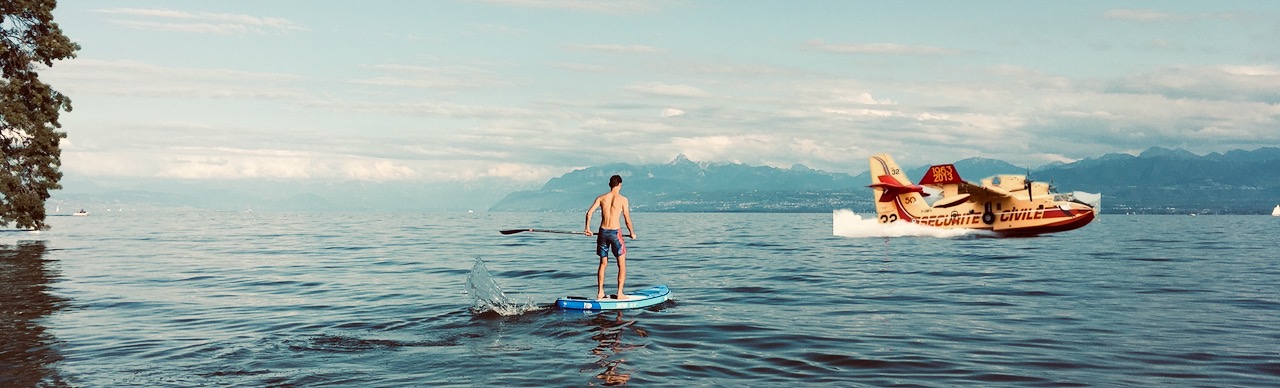
Second, a mental image that was hard to shake for me was the mind-blowing announcement that French firefighters are ready and equiped to refill their fleet of Canadair tankers in the Lake Leman – where we go paddling and swimming. This was an image hard to shake, a clashing of worlds – so here’s an amateur attempt to make it real with some photo editing….
Source info/Acknowledgements:
- Thank you to the Federation Forestier Lémanique for organising this workshop.
- Opening image of “Fire above Rolle”: composite image, base is my photo (CK, 2019) and fire cut-out from EHN.
- Final image “Canadair on Lake Geneva”: composite image, base is my photo (CK, 2021) and plane cut-out is from here.
 Christian Kull