Vegetation fire and cultural landscapes in Fiji

March 8, 2014

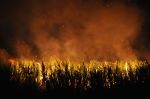
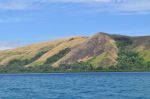
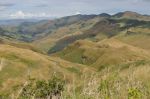
There are three main types of fire in Fiji.  Sugar cane farmers burn their fields to facilitate hand harvesting.  Village farmers clear forest plots, fallow fields, and secondary vegetation for diverse crops using fire.  And finally, the fires that cover the most ground are those set in the grasslands of the drier, lee-side of the islands.  And of course there are occasionally fires that cause trouble – late last year I saw a major fire burning through the pine plantations in southeastern Viti Levu.

Read the rest of this entry »


Pyric phases in Madagascar’s longer-than-presumed prehistory

August 7, 2013

An exciting archaeological find by Bob Dewar [1] and colleagues suggests the presence of hunter-gatherers on Madagascar around 4000 years ago, which essentially doubles the length of the history of Madagascar’s human settlement. Their discovery, published in PNAS [2], suggests four thousand years of people living, burning, cultivating, shaping, transforming, and developing the island’s environment, instead of around two thousand [3]. From a pyrogeography perspective, Dewar and colleagues make an important point towards the end of their paper: Read the rest of this entry »


The unexceptional fires in Madagascar’s grasslands

March 8, 2012

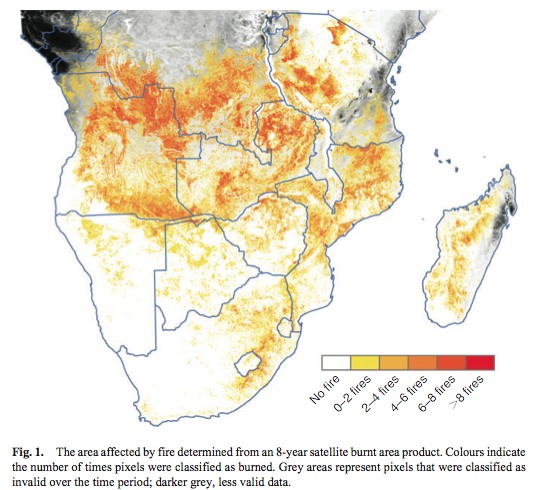
The prehistoric dynamics of fire, vegetation, and humans in Madagascar are still not resolved, though one might get a different impression from the simplified narrative told to galvanise conservation action.  Clearly, humans visited, hunted, and eventually settled the island over the last several thousand years, and lit the vegetation on fire throughout.   But what kinds of fire, in what kind of vegetation, how often, and with what impact?  Charcoal and pollen in lake sediment cores and archaeological digs have informed most of our recent scientific understandings of fire history on the island.  Perhaps further answers and hypotheses can be found from innovative botanical, remote sensing, and modelling research being done in Africa.  Most striking perhaps – in the face of all the alarmist discourse about the menace des feux de brousse in Madagascar – is how unimpressive Madagascar’s fires appear in any remote sensing image that includes neighbouring Africa (this one is taken from Archibald et al. 2010 in the International Journal of Wildland Fire).

8 years of African fire satellite fire data

Read the rest of this entry »