July 17, 2014
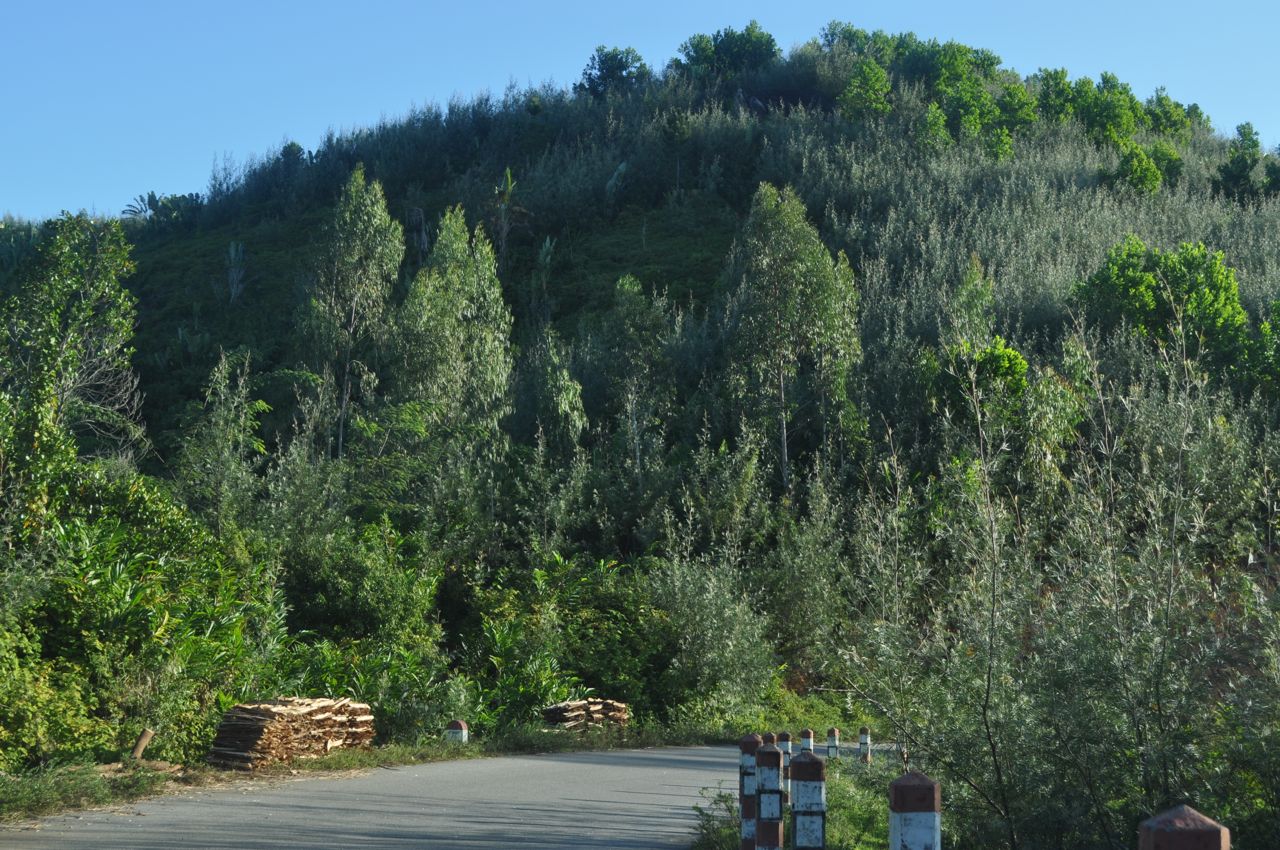
I recently returned from my 11th trip to Madagascar in 22 years. My main goal was to scope out potential field sites for an ARC-supported research project entitled “A weed by any other name? Comparing local knowledge and uses of environmental weeds around the Indian Ocean” (with collaborators Priya Rangan, Charlie Shackleton, and Nitin Rai). I took two week-long trips from the capital, first south to my old highland stomping grounds around Antsirabe and Ambositra, and second east to the rice bread-basket of Lake Alaotra, the rainforest escarpment at Andasibe and Beforona, and the coastal plains and hills around Vatomandry. It was also a good opportunity to renew personal and professional connections, including at the University of Antananarivo’s forestry school (ESSA-Forêts), where I was invited to give a presentation. What did I find?

Neo-Australian landscapes along RN11a in eastern Madagascar: Grevillea, Eucalyptus, Acacia…
Read the rest of this entry »
 2 Comments |
  Acacia, Introduced and Invasive Plants, Madagascar, Research |
  Permalink
 Posted by christiankull
September 25, 2013
The team of our current ARC-funded project on local knowledge and uses of environmental weeds recently assembled in Kununurra, far northwest Australia. The project will compare local people’s views of “weeds” across four case studies in four countries around the Indian Ocean – India, South Africa, Madagascar, and Australia. My Monash colleague Priya Rangan and I are collaborating with Charlie Shackleton (Rhodes University, South Africa) and Ramesh Kannan (ATREE, India), supported by Tom Bach (doctoral student on our previous ARC grant) and Pat Lowe (Kimberley-based author and environmentalist). Read the rest of this entry »
1 Comment | Acacia, Conservation, Introduced and Invasive Plants, Political ecology, Research | Tagged: research, weeds | Permalink
Posted by christiankull
March 20, 2013
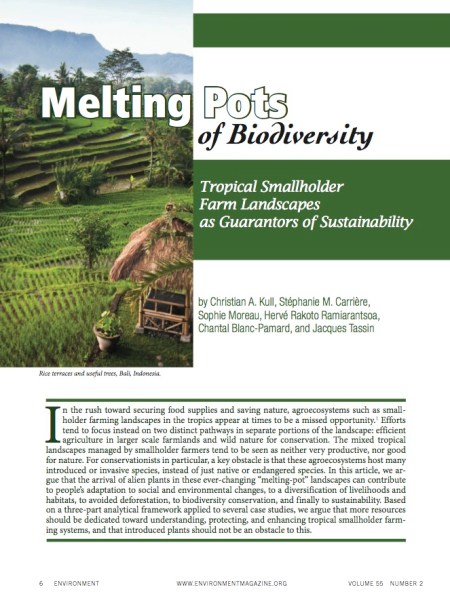
What happens when you combine human labour, introduced plants, and particular societal histories and structures in a certain tropical landscape? You end up with anthropogenic or cultural landscapes – the “matrix” in current ecological jargon – such as the domesticated forests1 of southeast Asia, the tree gardens of Caribbean or Pacific islands, the shambas of Africa, the rice terraces of Madagascar. Despite their aesthetic and cultural attractions, these smallholder farming landscapes are directly or implicitly critiqued by many – for not being as productive as modern industrial agriculture, for trapping people in rural poverty, and for taking up space at the expense of natural habitats. In two recent papers with French collaborators, I argue instead that such landscapes can be sustainable sources of useful products, can facilitate vibrant and resilient rural communities, and can be resilient contributors to the functioning of local and global biophysical systems.
Read the rest of this entry »
Leave a Comment » | Conservation, Development, Introduced and Invasive Plants, Research, Smallholder farming, Sustainability | Tagged: agriculture, biodiversity, hotspots, invasive alien species, sustainability, tropics | Permalink
Posted by christiankull
March 9, 2013
A few weeks ago I attended a workshop by this name in Wollongong, organized by Lesley Head, Jenny Atchison, and Nick Gill. With keynote papers by Richard Hobbs, known for the ‘novel ecosystems‘ concept, and by Brendon Larson, known for his book Metaphors for Environmental Sustainability, and with presentations by participants as diverse as uniformed state Noxious Weeds Inspectors, indigenous rangers, government scientists, and historians of science, we kicked off a fantastic conversation on how weeds in the landscape are already a ‘new normal’. The threat of invasion is old news; the challenge of living with invasives is the new. In this respect, managers of environmental weeds could learn from those who have focused on cropfield or pasture weeds – they have been ‘living with’ weeds for a long time, and don’t see the world in such black and white terms. For more information and comments, see this Blog by the workshop organisers.
Leave a Comment » | Introduced and Invasive Plants, Research | Tagged: conference, invasion biology, invasive alien plants, weeds | Permalink
Posted by christiankull
December 12, 2012
Are Australian acacias planted overseas miracle plants for rural development, or are they the worst kind of environmental weeds? The battle lines appear rather stark at times. At least when one reads environmentalist Tim Low’s rebuttal to a critique that Jacques Tassin and I wrote of his views. We thought our statement to be tempered and tried to build a reasonable case for responsible use of exotic agroforestry trees (see also previous blog). But Low calls us “in denial about dangerous aid”, flogs a misplaced example about mesquite in an argument about acacia, all the time preaching his argument to the converted in the journal Biological Invasions. Read the rest of this entry »
2 Comments | Acacia, Development, Introduced and Invasive Plants, Political ecology, Research, Sustainability, Vietnam | Tagged: Acacia, development aid, environment, forestry, invasive alien species, miracle trees, Vietnam | Permalink
Posted by christiankull
August 7, 2012
The landscapes that characterize different places on the earth, and from which many people earn their livelihoods and their sense of place, and which support diverse flora and fauna, are often built with a mix of local and introduced plants. Sometimes, introduced plants succeed so wildly in their new home that people come to see them as weeds or pests, crowding out crops or native species, changing soil conditions, altering fire regimes, or affecting the water table. The field of invasion biology emerged over the past few decades seeking to document, understand, and stop such “alien invasions”. But the fervour of this effort has at times crashed head-on with alternative worldviews. One of South Africa’s top weeds, for example, is the Australian native silver wattle, also naturalized in France where it is celebrated for its winter flowers and as an ingredient for Chanel No. 5 and other perfumes [1][2]. Such conflicting outlooks were on stark display at a workshop I attended in October 2010 at Stellenbosch, South Africa, on Australian acacias as a global experiment in biogeography.
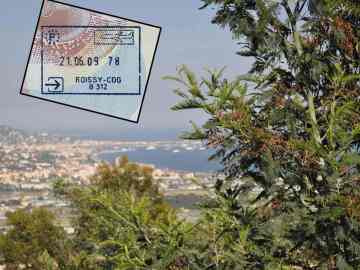
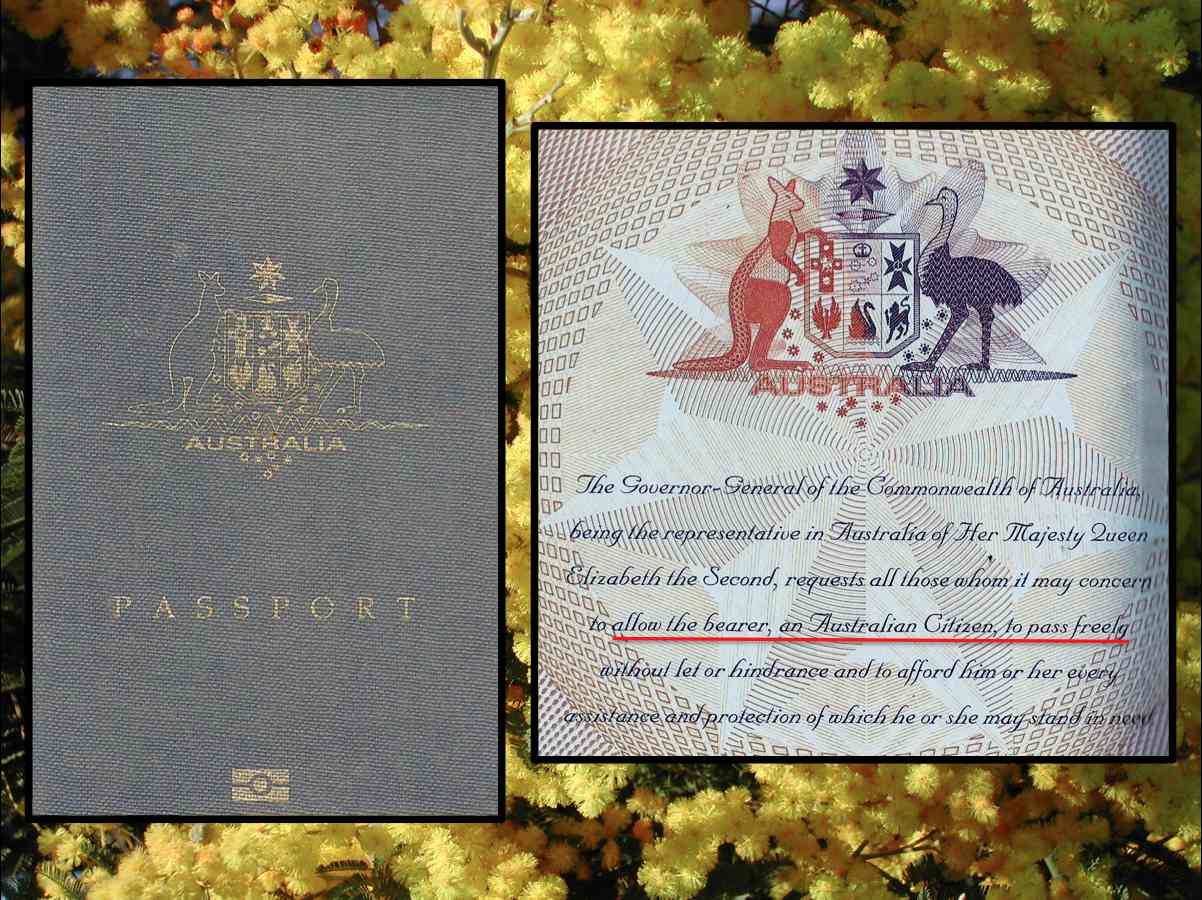
Picture 1: Do plants need passports? Who should control plant movements, and on what basis? Silver wattle (Acacia dealbata), native to Australia, invasive and assimilated as mimosa in the Côte d’Azur, France.
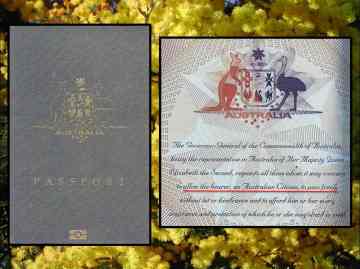
Picture 2: Do Australian acacias need passports? Australian passports specify “free passage without let or hindrance”…
Read the rest of this entry »
3 Comments | Acacia, Introduced and Invasive Plants, Political ecology, Research | Tagged: australian acacias, control, environment, eradication, geographic perspectives, invasion biology, invasive alien plants, landscapes, livelihoods, nature, plant transfers, quarantine, region, sense of place | Permalink
Posted by christiankull
November 8, 2011
It is usually the rich and unique endemic vegetation of Madagascar that gets all the attention from tourists, biologists, and conservationists. Yet the species that humans brought to the island also deserve attention as plants emblematic of human history and as builders of societies and environments. What would the island be without rice, litchi, and vanilla? What would the highland landscape be like without eucalypts, apples, and jacaranda? Some of the new plants cause problems by becoming too successful (the stories of prickly pear, water hyacinth, pine, or various crop field weeds are instructive), but many have contributed to the landscapes of the island – as the raw materials of peoples’ lives; as colours, fascinations, smells, and sights; as memories and emotions; and even as habitat, perches, and food for lemurs, bats, and endemic birds. An article that I’ve just published together with several colleagues seeks to analyse this new flora, which we catalogue in a lengthy inventory – the first of its kind in 80 years.
1 Comment | Introduced and Invasive Plants, Madagascar, Research | Permalink
Posted by christiankull
March 25, 2011
One of the key questions of our current research project is how, when, and why the ‘mimosa bush’ or ‘cassie’ tree got to Australia. Acacia farnesiana, also known as Vachellia farnesiana (if you agree with the splitting of the acacia genus) is presumed by many botanists to be native to a broad swath of the Americas, from Bolivia north to Texas. Yet it exists all around the tropical and subtropical world. The first British explorers of interior Australia found it growing all over the interior northern part of the continent. How did it get there, then? How long has it been there? The answer matters, because environmental managers these days want to know if a plant is ‘native’ or ‘alien’, as this has repercussions (for better or worse) on how they approach it.
Read the rest of this entry »
Leave a Comment » | Acacia, Fiji, Introduced and Invasive Plants, Research | Permalink
Posted by christiankull



 Christian Kull