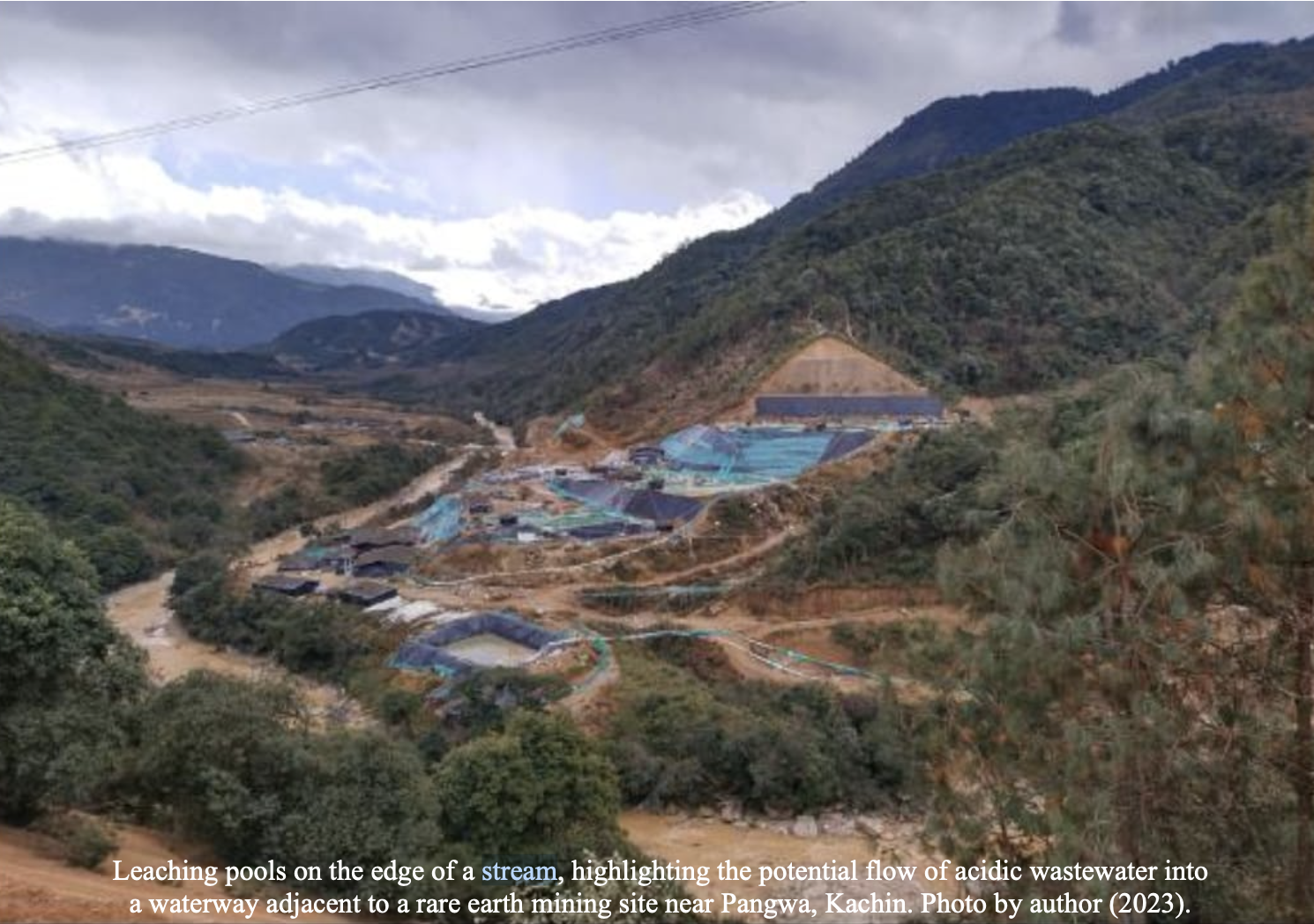
Sidney Mintz* once wrote how the links between a spoon of sugar in the tea of an English worker, a plantation in the Caribbean, and the rise of colonialism and capitalism were like yet another chorus of the children’s song ‘dem bones’: the leg bone’s connected to the knee bone, the knee bone’s connected to the thigh bone, the thigh bone’s connected to the hip bone… Such links have only multiplied and thickened with time. Today’s global transition to a clean-energy economy (think electric cars and wind turbine generators) requires high-performance permanent magnets. These components need “rare earths”, minerals like dysprosium and terbium. The knee bone shakes all the way down to the ankle bone, the foot bone, and the toe bone…. and from a electric car on my street we go all the way to landscapes ravaged by rare earth mining in a country torn by civil war – Kachin state, Myanmar, right on the border with China.
Thi Thi Han’s thesis explores the dark side of clean energy. She asks why rare earths are framed as “critical minerals” (which we need to access at all costs) as opposed to being framed as “conflict minerals” (whose exploitation is intimately linked to violent resource frontiers, which need to be regulated)? She does this with gutsy, engaged, and reflexive fieldwork in the border areas of Kachin state, and just yesterday defended it in a public defence here at the University of Lausanne. Congratulations to Thi Thi!
Read the rest of this entry »


 Posted by christiankull
 Christian Kull