Why forest transitions aren’t always sustainable: nine pitfalls

May 22, 2024

Stopping and reversing deforestation is a foremost priority in much of the tropics. Numerous policies and programs try to stem forest clearance, encourage tree planting, and restore forest landscapes. The hope is to promote “forest transitions” similar to the historical turnaround in forest cover trajectories in wealthy temperate countries. Such efforts have become all the more urgent given the climate and biodiversity crises. Yet it is often assumed that more forests is better and more sustainable, without careful consideration of how and where it happens, who wins and who loses, and what kinds of forests. In a recent open access paper, we identify nine pitfalls to such assumptions. Hopefully this inspires researchers, policymakers, and leaders to promote more diverse transitions to sustainable forest use and management.

The nine pitfalls and their implications for research and policy. (Figure 2 from our paper in the journal Environmental Conservation). With photos of forest landscapes across Southeast Asia: (a) plantations of rubber and acacia spreading in central Vietnam with remnant natural forest on hilltops; (b) ancestral lands of Pala’wan farmers on Palawan, Philippines; (c) announcement of an application for a communal land title for heritage land that has already been converted to oil palm plantations in Sabah, Malaysia; and (d) paddy rice fields and upland forest with swidden in Hsipaw, Myanmar. Photos (a) Tran Nam Thang, (b) Wolfram Dressler, (c) Jennifer Bartmess, (d) Kevin Woods.
Read the rest of this entry »

The geopolitics of Madagascar’s environment

January 8, 2013

Who controls Madagascar’s flora, fauna, and landscapes?  How, and for whom, are its forests, grasslands, and waters governed?  Over the past three decades, Madagascar’s local environments have become more and more internationalized – subjected to western worldviews and gazetted into protected areas with foreign funding.

Read the rest of this entry »


The Third Wattle War: environment versus development?

December 12, 2012

Are Australian acacias planted overseas miracle plants for rural development, or are they the worst kind of environmental weeds?  The battle lines appear rather stark at times.  At least when one reads environmentalist Tim Low’s rebuttal to a critique that Jacques Tassin and I wrote of his views.  We thought our statement to be tempered and tried to build a reasonable case for responsible use of exotic agroforestry trees (see also previous blog).  But Low calls us “in denial about dangerous aid”, flogs a misplaced example about mesquite in an argument about acacia, all the time preaching his argument to the converted in the journal Biological Invasions.   Read the rest of this entry »


On French geography and political ecology

September 6, 2012

During a live radio interview today on Radio France Culture (info / listen), the host Sylvain Kahn put me on the spot, asking whether, as an Australian geographer I thought that French geography was missing out on the environment question.  I deflected the question, not feeling qualified to judge an entire disciplinary tradition I have only partial exposure to.  But as far as I understand from my conversations with French geographers, his question was not innocent. Read the rest of this entry »


Do plants need passports?

August 7, 2012

The landscapes that characterize different places on the earth, and from which many people earn their livelihoods and their sense of place, and which support diverse flora and fauna, are often built with a mix of local and introduced plants.  Sometimes, introduced plants succeed so wildly in their new home that people come to see them as weeds or pests, crowding out crops or native species, changing soil conditions, altering fire regimes, or affecting the water table.  The field of invasion biology emerged over the past few decades seeking to document, understand, and stop such “alien invasions”.   But the fervour of this effort has at times crashed head-on with alternative worldviews.  One of South Africa’s top weeds, for example, is the Australian native silver wattle, also naturalized in France where it is celebrated for its winter flowers and as an ingredient for Chanel No. 5 and other perfumes [1][2].  Such conflicting outlooks were on stark display at a workshop I attended in October 2010 at Stellenbosch, South Africa, on Australian acacias as a global experiment in biogeography.

Picture 1: Do plants need passports? Who should control plant movements, and on what basis? Silver wattle (Acacia dealbata), native to Australia, invasive and assimilated as mimosa in the Côte d’Azur, France.

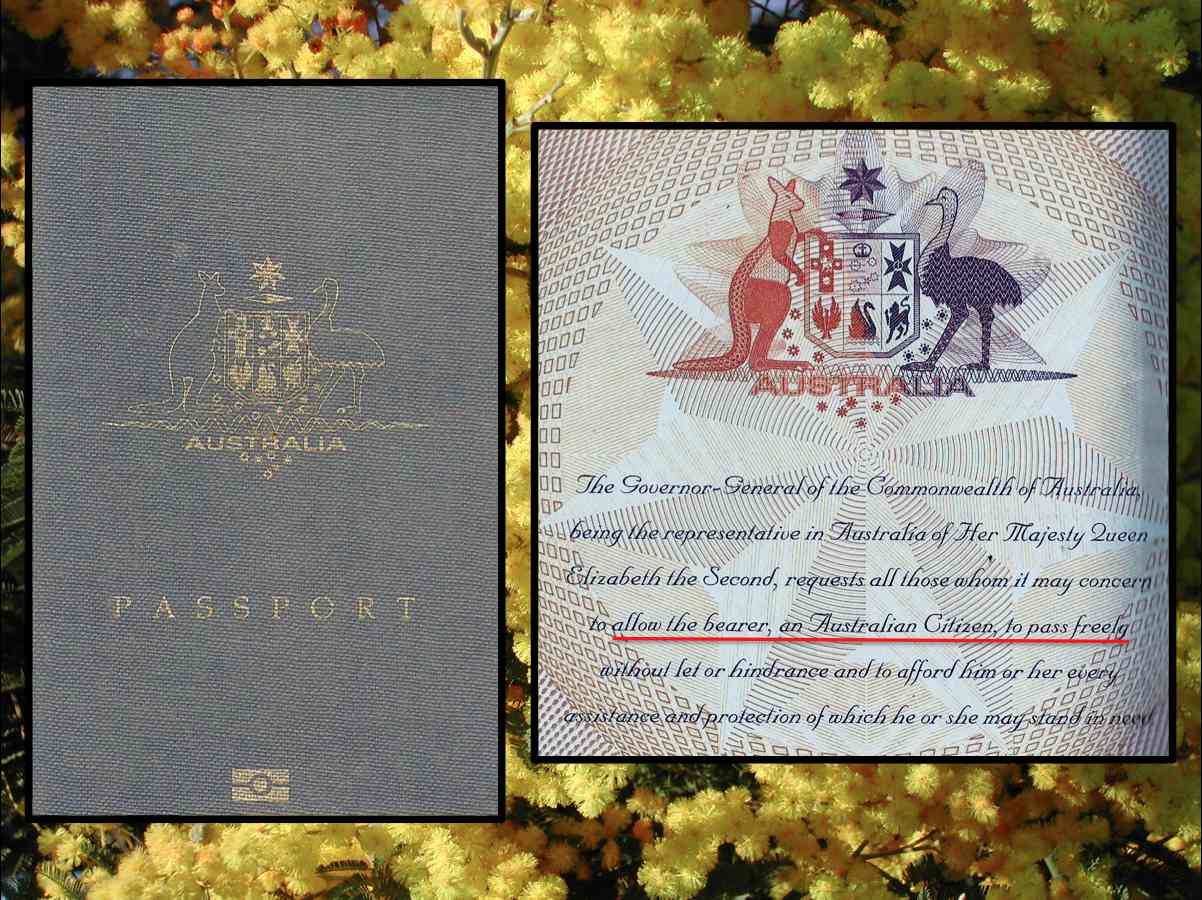
Picture 2: Do Australian acacias need passports? Australian passports specify “free passage without let or hindrance”…

Read the rest of this entry »