We are offering a funded PhD scholarship for research on the governance of tree planting and forest restoration in Madagascar, focused on land and tree tenure, building on Ribot and Peluso’s (2003) theory of access. Come join us in an exciting University of Lausanne – University of Antananarivo collaboration funded by the Velux Stiftung. Students will be based in the doctoral school GRND at the University of Antananarivo, with co-supervision by Prof. Bruno Ramamonjisoa, me and Stephanie Mansourian. Deadline October 1.
Read the rest of this entry »Bourse doctorale : aspects fonciers (terre, arbres) dans la gouvernance du reboisement à Madagascar
September 12, 2023
 1 Comment |
  Madagascar, Research | Tagged: forest restoration, governance, land tenure, PhD scholarship, tree planting |
  Permalink
 Posted by christiankull
Acacia tree farmers in central Vietnam
July 10, 2023Colleagues from the FT Viet project have now published their top-notch research based on a set of rigorous in-depth surveys of tree farmers in Thừa Thiên-Huế province, central Vietnam. About a fifth of this province is now covered with tree plantations, mostly comprising the Australasian fast-growing tree Acacia magnum and Acacia magnum x Acacia auriculiformis hybrids. They interviewed 180 farmers across districts in the coastal plains, midland hills, and uplands, with half involved in Forest Stewardship Council groups that produce timber sawlogs under FSC certification standards, and half not involved (these tended to produce wood chips instead). The two published articles are an extremely rich and well-described source for understanding the development of acacia plantations over time, their relation to farmer assets and livelihoods, changes in land management, and farmer’s views on environmental challenges and future opportunities.

Leave a Comment » | Acacia, Development, Research, Smallholder farming, Vietnam | Tagged: livelihoods, timber certification, tree plantations, Vietnam | Permalink
Posted by christiankull
Bourses doctorales sur la gouvernance de l’afforestation et de la restauration forestière à Madagascar
July 10, 2023Two new funded PhD scholarships for research on the governance of tree planting and forest restoration in Madagascar (one focused on land and tree tenure and resource access; the other focused on the dynamics, networks, and power relations of involved actors and institutions). Come join us in an exciting University of Lausanne – University of Antananarivo collaboration funded by the Velux Stiftung. Students will be based in the doctoral school GRND at the University of Antananarivo, with co-supervision by Prof. Bruno Ramamonjisoa, me and Stephanie Mansourian. Deadline August 20.
Read the rest of this entry »
Leave a Comment » | Madagascar, Research | Tagged: forest restoration, governance, land tenure, PhD scholarship, tree planting | Permalink
Posted by christiankull
Ethnographic fieldwork on farms, fires, and forests in Madagascar
June 27, 2023I was interviewed by our Faculty’s research consultant on doing research in Madagascar. Here’s the result, with some fun pictures.
Leave a Comment » | Madagascar, Research | Tagged: fieldwork, Madagascar | Permalink
Posted by christiankull
Reflecting on the future of Vietnam’s forests
June 16, 2023
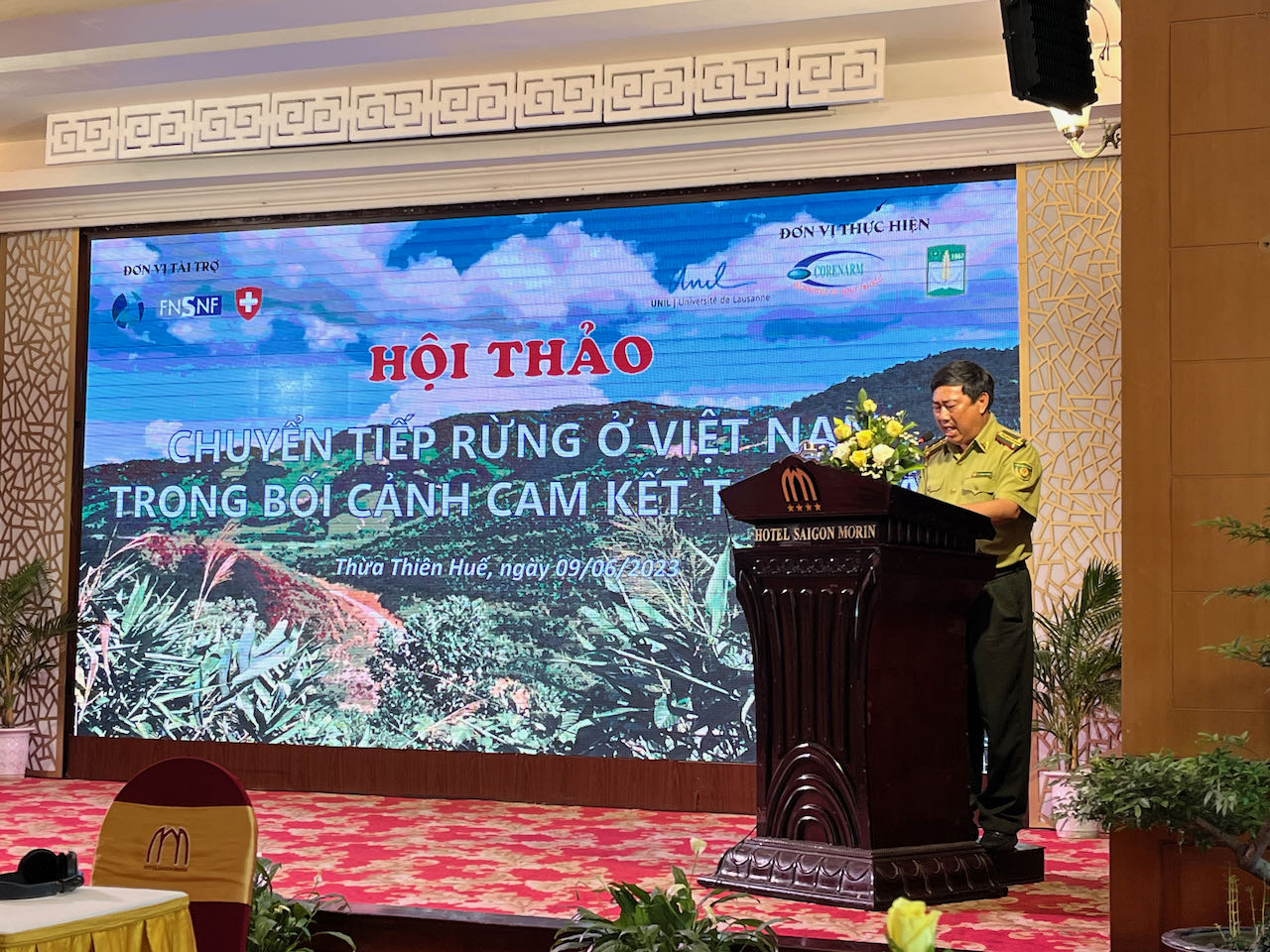
Our FT Viet project recently held a science-policy workshop on forest change and sustainability. After over five years of project activities, it was a chance to report on project outcomes and bring together key actors to reflect on the trends, direction, and sustainability of forest management in Vietnam. The 40+ people assembled in a hotel conference room in Hue on June 9 included people working at the national level in Hanoi, others from Thua Thien Hue and nearby provinces in the north Central region, and local stakeholders. There were university researchers and leaders, officials from the national payments for ecosystem services program, conservationists, leaders of forest certification programs, NGOs, and, of course, state foresters in their green uniforms.
Read the rest of this entry »
1 Comment | Acacia, conference, Conservation, Development, Doctoral students, Research, Vietnam | Tagged: Acacia, forest transition, Vietnam | Permalink
Posted by christiankull
New project: what type of fire regime for what type of benefit (carbon, biodiversity, livelihoods…) in Southern Africa and Madagascar
October 13, 2022
I am happy to announce that we have received funding from SNIS (Swiss Network for International Studies) for a new project. Principal member of the project is fire ecologist and remote sensing specialist Víctor Fernández-García (see also Victor’s blog site), with collaborators at the universities of Antananarivo, Eduardo Mondlane, Swansea, Lausanne, and Léon, and at FAO and SANParks.
Read the rest of this entry »
1 Comment | Conservation, Fire, Madagascar, Research | Tagged: fire regime, Kruger National Park, Madagascar grasslands, remote sensing | Permalink
Posted by christiankull
Madagascar’s fire regimes compared to the rest of the tropics
June 15, 2022Bushfire is often seen as symbolic of environmental catastrophe on Madagascar. But is it? A global comparison of fire regimes based on satellite image data suggests care in jumping to such conclusions. A recent article in Global Change Biology, led by Leanne Phelps and to which I contributed, finds that the island’s fire regimes have analogues to 88% of fire regimes in the global tropics with similar climate and vegetation. Madagascar’s fires, while exceptionally vilified, are not exceptional. It also demonstrates that the large, landscape-scale grassland fires common across highland and western Madagascar have no relationship to forest loss; indeed forest loss occurs in places without large-scale fires.

Leave a Comment » | Fire, Madagascar, Research | Tagged: bushfire, Madagascar, remote sensing | Permalink
Posted by christiankull
What is “political ecology” these days?
May 31, 2022
In a recent doctoral reading group here at the University of Lausanne, we discussed the 1987 text by Blaikie and Brookfield titled Land Degradation and Society, which is often cited as the foundational text for the field of political ecology. Comparing that groundbreaking work with current discussions under the political ecology label shows both continuities and new trends. Continuities include concern over environmental change and a ‘double posture’ of engaging with science on the issue at hand as well as a critical perspective with that science (for instance measuring soil degradation as well as asking what that concept means); concerns with the impacts of capitalism and colonialism; attention to property systems etc etc. Newer trends include the full-blown arrival of various approaches steeped in continental philosophy (poststructuralism, actor networks, assemblages, hegemony, bare life, governmentality….) and in diverse intersectional and decolonial postures. But where is the field now?
Read the rest of this entry »
1 Comment | Political ecology, Research | Tagged: bibliometrics, epistemic communities, lexicometrics, political ecology | Permalink
Posted by christiankull
Acacias (wattles, mimosas) in your landscape: survey
February 2, 2022
Together with Charlie Shackleton, I am updating our 2011 global study of the adoption, use, and perception of non-native Australian acacias in landscapes around the world. We seek to identify changes and trends in the presence of these trees and how they have been welcomed (or not), and used (or not). To that effect, we have prepared a brief online survey.
Read the rest of this entry »
1 Comment | Acacia, Introduced and Invasive Plants, Research | Permalink
Posted by christiankull
The politics of a “forest transition” in Vietnam: PhD of Nguyen Thi Hai Van
December 6, 2021
I am thrilled to announce that Nguyen Thi Hai Van has successfully defended her PhD. Using a political ecology approach, Van investigated the dramatic changes in the forest landscapes of A Luoi, a mountainous district in the central coast of Vietnam. In this humid tropical landscape, natural forests were destroyed by war and logging, but forest cover has rebounded in the last 20 years due to widespread acacia plantations as well as conservation activities in remaining forests. Much of these changes have been attributed to successive state policies and programs, such as the allocation of forest lands to local people, the massive promotion of reforestation, and the implementation of ecosystem service payment schemes. Van, however, looks “under the hood” of the successive layers state policies to see how they translate into specific outcomes in specific places in conjunction with local aspirations and economic pressures. In the end, she argues that not only has the forest been transformed, but also the people – with ‘new forest people’ undertaking new livelihoods with new identities.
Read the rest of this entry »
2 Comments | Acacia, Development, Doctoral students, Research, Sustainability, Vietnam | Permalink
Posted by christiankull

 Christian Kull