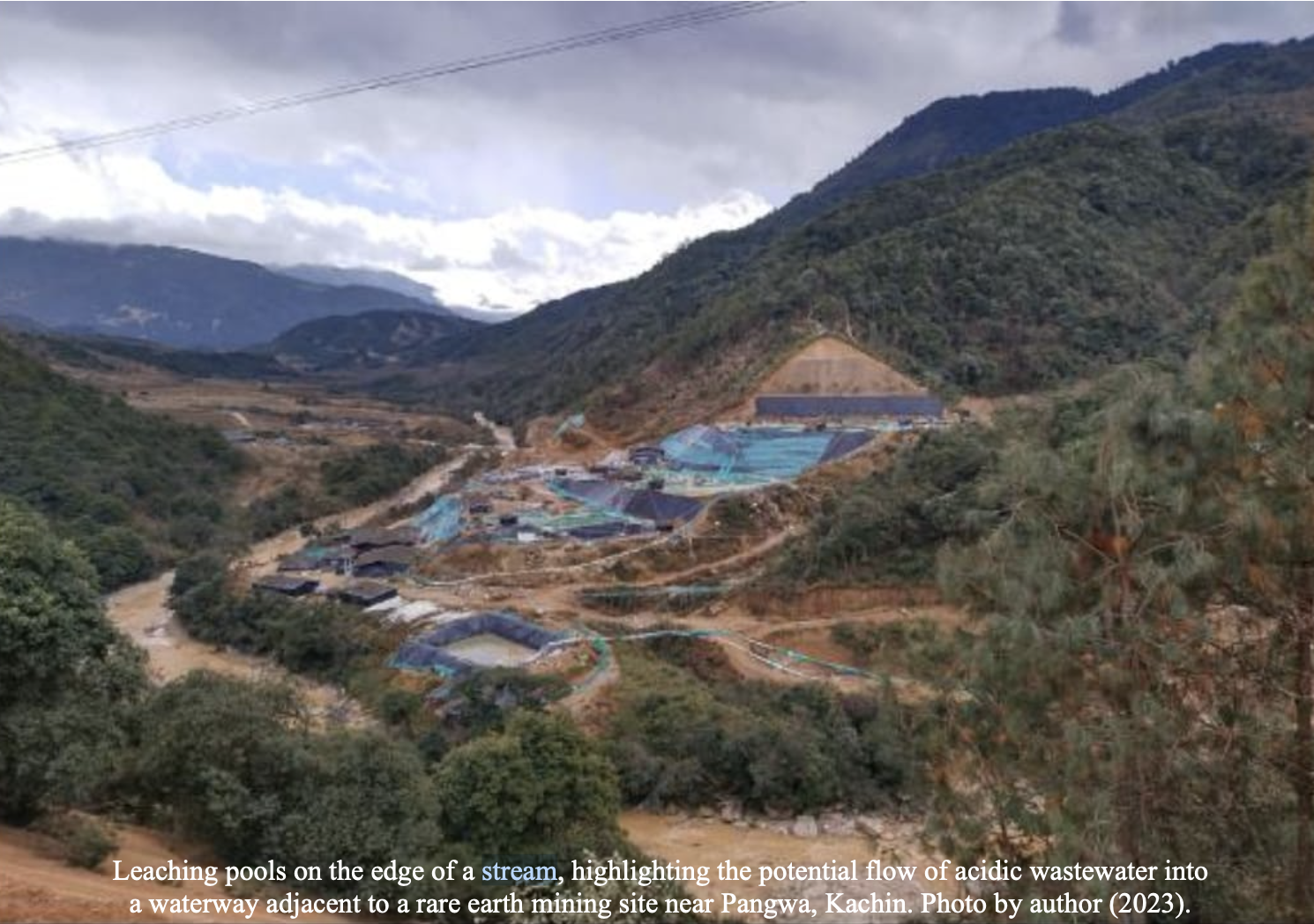
Sidney Mintz* once wrote how the links between a spoon of sugar in the tea of an English worker, a plantation in the Caribbean, and the rise of colonialism and capitalism were like yet another chorus of the children’s song ‘dem bones’: the leg bone’s connected to the knee bone, the knee bone’s connected to the thigh bone, the thigh bone’s connected to the hip bone… Such links have only multiplied and thickened with time. Today’s global transition to a clean-energy economy (think electric cars and wind turbine generators) requires high-performance permanent magnets. These components need “rare earths”, minerals like dysprosium and terbium. The knee bone shakes all the way down to the ankle bone, the foot bone, and the toe bone…. and from a electric car on my street we go all the way to landscapes ravaged by rare earth mining in a country torn by civil war – Kachin state, Myanmar, right on the border with China.
Thi Thi Han’s thesis explores the dark side of clean energy. She asks why rare earths are framed as “critical minerals” (which we need to access at all costs) as opposed to being framed as “conflict minerals” (whose exploitation is intimately linked to violent resource frontiers, which need to be regulated)? She does this with gutsy, engaged, and reflexive fieldwork in the border areas of Kachin state, and just yesterday defended it in a public defence here at the University of Lausanne. Congratulations to Thi Thi!
All too often, efforts to restore forests and ecosystems treat the human dimensions as an afterthought. Biodiversity, or carbon offset payments, tend to come first. Yet ultimately, it is people who shape the need for, take decisions on, carry out, and are impacted by restoration. In a pair of short policy perspective articles led by my colleague Stephanie Mansourian, we outline the importance and relevance of human dimensions. The first one presents a five-pillar framework – stretching across scales from local to global – to help policymakers and practitioners think through the diverse places where a human focus is crucial. The second one uses the forest transition curve to illustrate how people are relevant at every stage of forest loss and potential recovery.
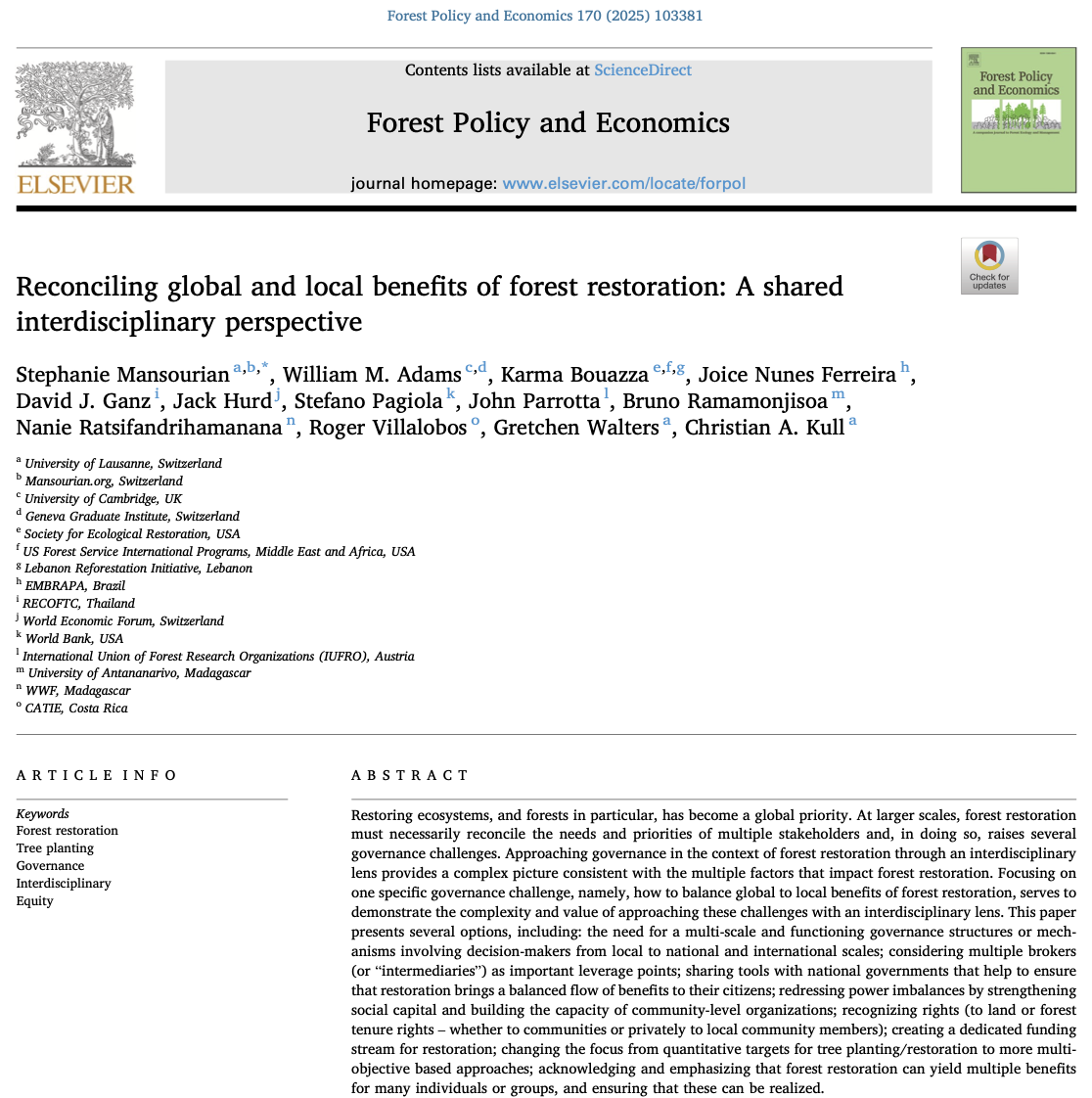
Seems like everybody is planting trees or restoring forestlands these days. The emphasis is often on carbon capture to attenuate climate change. But this emphasis on carbon offsets (and the money behind it) draws in powerful global actors and carbon market intermediaries. Meanwhile, the costs of forest restoration are all too often unjustly borne by less powerful, local people living in places where trees are planted or restored. How forest restoration efforts be governed so that benefits can accrue at all spatial scales, from global to local?
Stopping and reversing deforestation is a foremost priority in much of the tropics. Numerous policies and programs try to stem forest clearance, encourage tree planting, and restore forest landscapes. The hope is to promote “forest transitions” similar to the historical turnaround in forest cover trajectories in wealthy temperate countries. Such efforts have become all the more urgent given the climate and biodiversity crises. Yet it is often assumed that more forests is better and more sustainable, without careful consideration of how and where it happens, who wins and who loses, and what kinds of forests. In a recent open access paper, we identify nine pitfalls to such assumptions. Hopefully this inspires researchers, policymakers, and leaders to promote more diverse transitions to sustainable forest use and management.
The nine pitfalls and their implications for research and policy. (Figure 2 from our paper in the journal Environmental Conservation). With photos of forest landscapes across Southeast Asia: (a) plantations of rubber and acacia spreading in central Vietnam with remnant natural forest on hilltops; (b) ancestral lands of Pala’wan farmers on Palawan, Philippines; (c) announcement of an application for a communal land title for heritage land that has already been converted to oil palm plantations in Sabah, Malaysia; and (d) paddy rice fields and upland forest with swidden in Hsipaw, Myanmar. Photos (a) Tran Nam Thang, (b) Wolfram Dressler, (c) Jennifer Bartmess, (d) Kevin Woods.Read the rest of this entry »
Figure 6 from the paper (” Land cover ~1966 (a) and 1973 (b), and natural forest cover and transformations 1966–1979 (c, d).”)
The FT Viet project’s new paper in the journal Land Use Policy is a major contribution both to studies of “forest transitions” (the idea that as places develop over time, forest loss switches to forest regrowth) and to the specific history of forest dynamics in central Vietnam’s Thừa Thiên-Huế province. Led by Roland Cochard, with remote sensing whizzery contributed by Mathieu Gravey and colleagues, this paper is a very rich and careful historical analysis of fifty years of forest change based on remote sensing and documentary sources.
Wanting to preserve biodiversity in tropical forest areas without involving the local and indigenous communities that live there is neither fair nor effective, say ecologist Jacques Tassin and geographer Christian Kull. This was the tag line for our recent opinion piece published in the French newspaper Le Monde. Thanks so much to my friend and collaborator Jacques Tassin for involving me in this project. Below, I’ve made an English translation of the article, and also inserted some of the references that inspired us.
I am thrilled to announce that Nguyen Thi Hai Van has successfully defended her PhD. Using a political ecology approach, Van investigated the dramatic changes in the forest landscapes of A Luoi, a mountainous district in the central coast of Vietnam. In this humid tropical landscape, natural forests were destroyed by war and logging, but forest cover has rebounded in the last 20 years due to widespread acacia plantations as well as conservation activities in remaining forests. Much of these changes have been attributed to successive state policies and programs, such as the allocation of forest lands to local people, the massive promotion of reforestation, and the implementation of ecosystem service payment schemes. Van, however, looks “under the hood” of the successive layers state policies to see how they translate into specific outcomes in specific places in conjunction with local aspirations and economic pressures. In the end, she argues that not only has the forest been transformed, but also the people – with ‘new forest people’ undertaking new livelihoods with new identities.
I was recently invited to give a presentation at University College London’s “Human Ecology Research Group” seminar series, and was asked record it in advance. I thank HERG for the invitation and the very fruitful discussion! I’m pleased to share the presentation here.
Summary: Forest landscapes and forest lives are mutating rapidly in central Vietnam. Non-native acacia plantations have boomed, local people have refashioned their livelihoods around these trees, in a context of diverse state policies. What is ‘sustainability’ in the face of these dynamics? This presentation seeks to give an overview of the progress of the “FT Viet” R4D project. I start describing the empirical case, then address the sustainability question before finishing with some comments on interdisciplinarity.
With pride and pleasure I’d like to announce the successful doctorate of Mialy Andriamahefazafy, which she defended publicly on July 13. Mialy’s previous work with a marine conservation organisation in coastal Madagascar showed her that local fishers were complaining about big boats fishing offshore, while in the inland capital, government officials were keen on the revenue they could gain through access agreements with foreign tuna fleets. This inspiration led to her thesis work, in which investigated the socio-material matrix through which fishing occurs. She narrowed in on three main topics: how diverse actors ‘access’ the fish, how these actors ‘narrate’ their concerns over overfishing, and whether there is any sense in approaching this issue by appealing to a sense of ‘regional identity’. Mialy undertook fieldwork in three countries (Madagascar, Seychelles, and Mauritius), interviewing more than 223 individuals including small-scale fishers, industrial boat captains and sailors, government officials, cannery workers, retailers and more. Mialy also observed landings of tuna in ports both big and small, and practiced event ethnography by joining delegations to attend two international negotiations.
Malagasy grasslands are often ignored, or worse, deplored. Biological research concentrates in the forests, many still shrinking despite conservation efforts. Yet research by plant ecologist Cédrique Solofondranohatra adds another layer of argument to the case that Malagasy grasslands have an ancient history and are important reservoirs of biodiversity themselves. Despite this, recent tree-planting efforts for climate change mitigation (of the ‘trillion trees‘ mode) often seem to take the easy path formed by a century of habit: planting exotic pines, acacias, and eucalypts in the grasslands, perceived as open, available, fire-damaged, and worthless. A much more laudable goal would be to restore trees to areas recently deforested.


 Posted by christiankull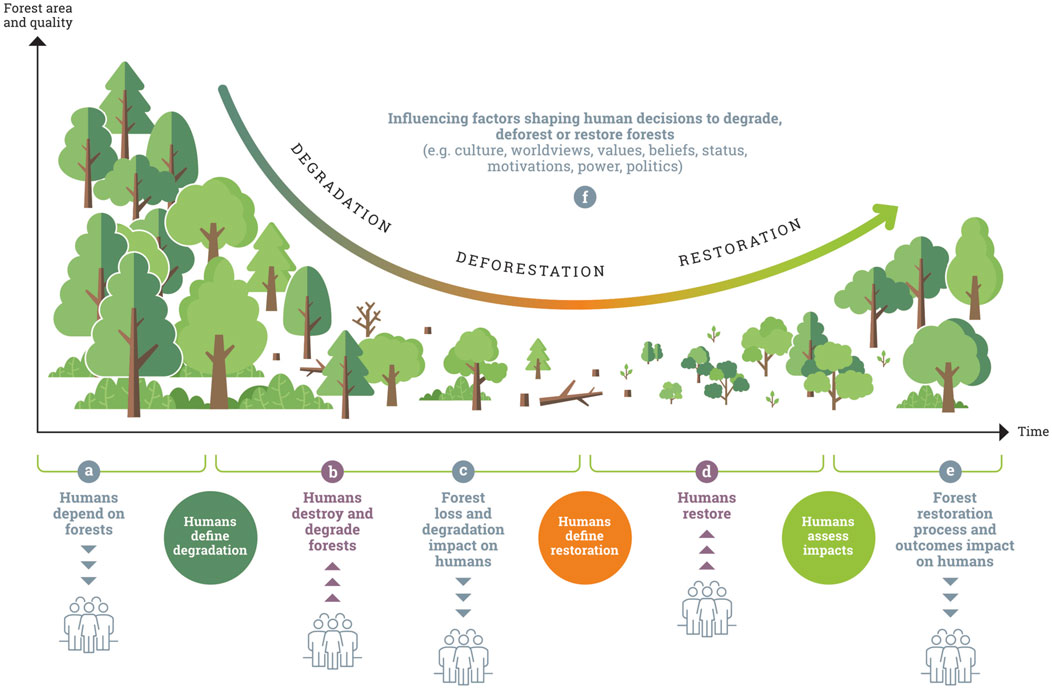



 Christian Kull