The “FTViet” project, which investigated the nature of forest transitions in central Vietnam through research, capacity building, and policy making is in its last year. Here’s a relaxing 15 minute video produced by our wonderful partners at the NGO Corenarm summarising the project. It gives a nice sense of the landscapes and people involved (Subtitles in English).
FT Viet project movie
June 21, 2023
 Leave a Comment » |
  Acacia, Conservation, Development, Vietnam | Tagged: forest transition, Vietnam |
  Permalink
 Posted by christiankull
Reflecting on the future of Vietnam’s forests
June 16, 2023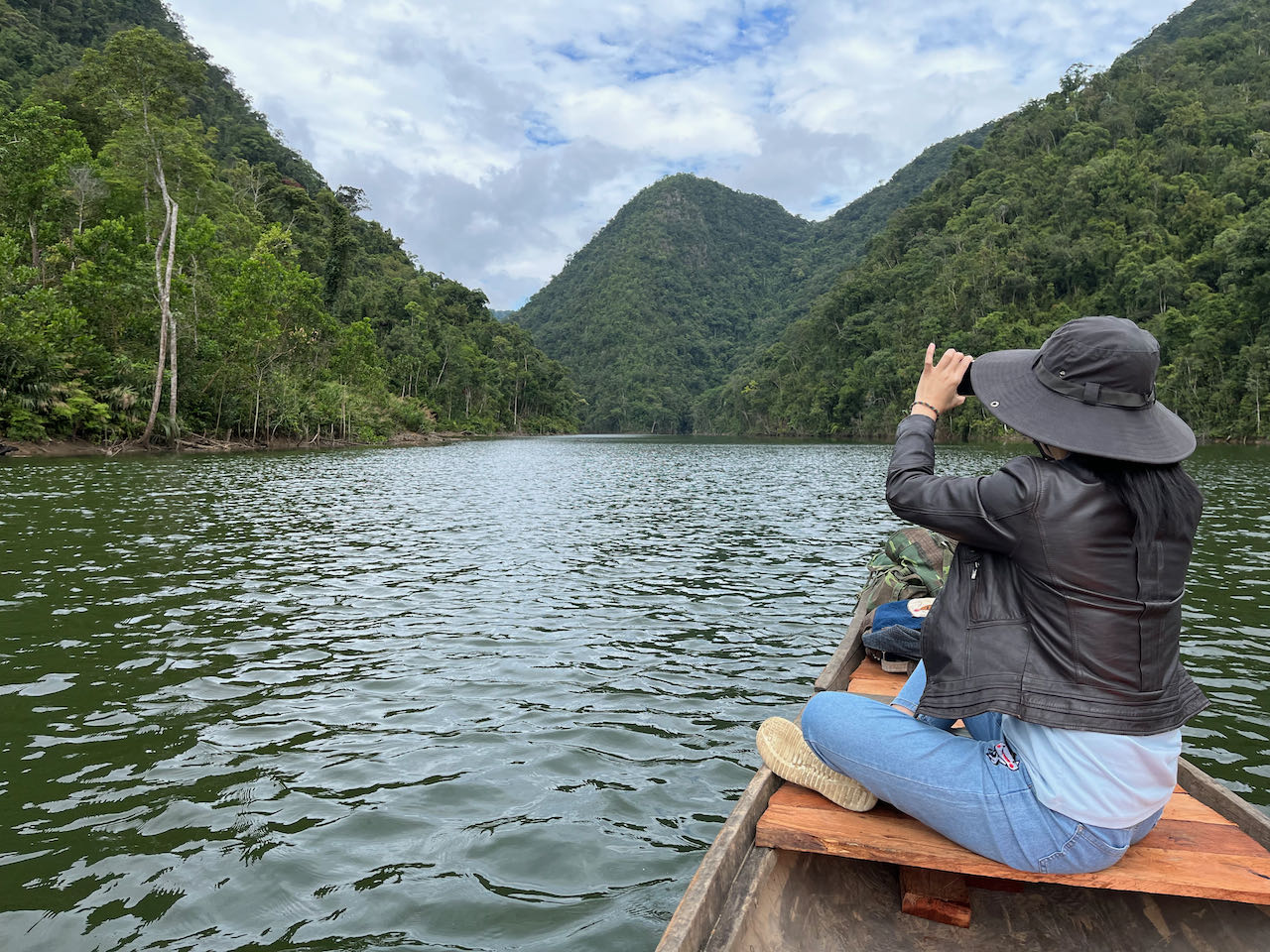
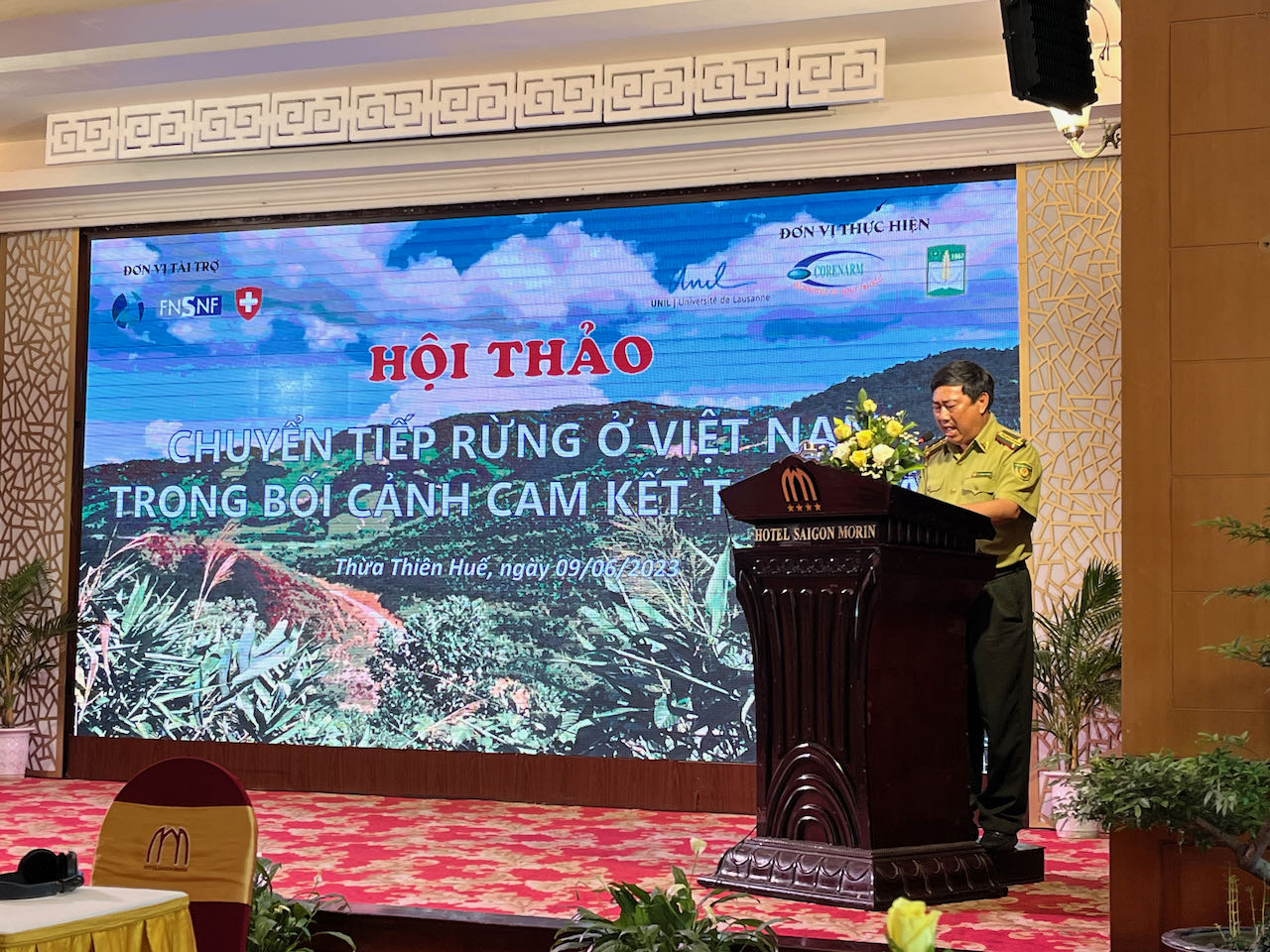
Our FT Viet project recently held a science-policy workshop on forest change and sustainability. After over five years of project activities, it was a chance to report on project outcomes and bring together key actors to reflect on the trends, direction, and sustainability of forest management in Vietnam. The 40+ people assembled in a hotel conference room in Hue on June 9 included people working at the national level in Hanoi, others from Thua Thien Hue and nearby provinces in the north Central region, and local stakeholders. There were university researchers and leaders, officials from the national payments for ecosystem services program, conservationists, leaders of forest certification programs, NGOs, and, of course, state foresters in their green uniforms.
Read the rest of this entry »
1 Comment | Acacia, conference, Conservation, Development, Doctoral students, Research, Vietnam | Tagged: Acacia, forest transition, Vietnam | Permalink
Posted by christiankull
Recognition of community land rights: a tool against tropical deforestation
March 23, 2023Wanting to preserve biodiversity in tropical forest areas without involving the local and indigenous communities that live there is neither fair nor effective, say ecologist Jacques Tassin and geographer Christian Kull. This was the tag line for our recent opinion piece published in the French newspaper Le Monde. Thanks so much to my friend and collaborator Jacques Tassin for involving me in this project. Below, I’ve made an English translation of the article, and also inserted some of the references that inspired us.
Read the rest of this entry »
Leave a Comment » | Conservation, Development, Political ecology, Sustainability | Tagged: community land rights, deforestation, indigenous people | Permalink
Posted by christiankull
The science, knowledge, and governance of thirsty eucalypts in Chile: PhD of Astrid Oppliger Uribe
February 22, 2023
I am pleased to announce Astrid Oppliger’s successful public defence of her PhD thesis entitled Production, Circulation and Application of Scientific Knowledge: Forest Hydrology and Policy-Making in Chile. Her thesis addresses debates over forest plantations and water scarcity. She focusses on her native Chile’s forest plantation sector, where vast areas of “water sucking” eucalyptus plantations gained attention as the country struggles with multi-year droughts. She is particularly interested in how science interacts with policy, notably in the governance of the environment by diverse actors across industry, the state, and academia. She draws on the intersection of two main academic schools – political ecology and STS (science and technology studies) – to trace the ways in which scientific knowledge on forest hydrology is produced, circulated, and applied in the multi-actor governance of eucalyptus plantations. Here’s an interview on her work in the university’s magazine Uniscope.
Read the rest of this entry »
Leave a Comment » | Doctoral students | Permalink
Posted by christiankull
Explaining and using theories of ‘power’ in conservation
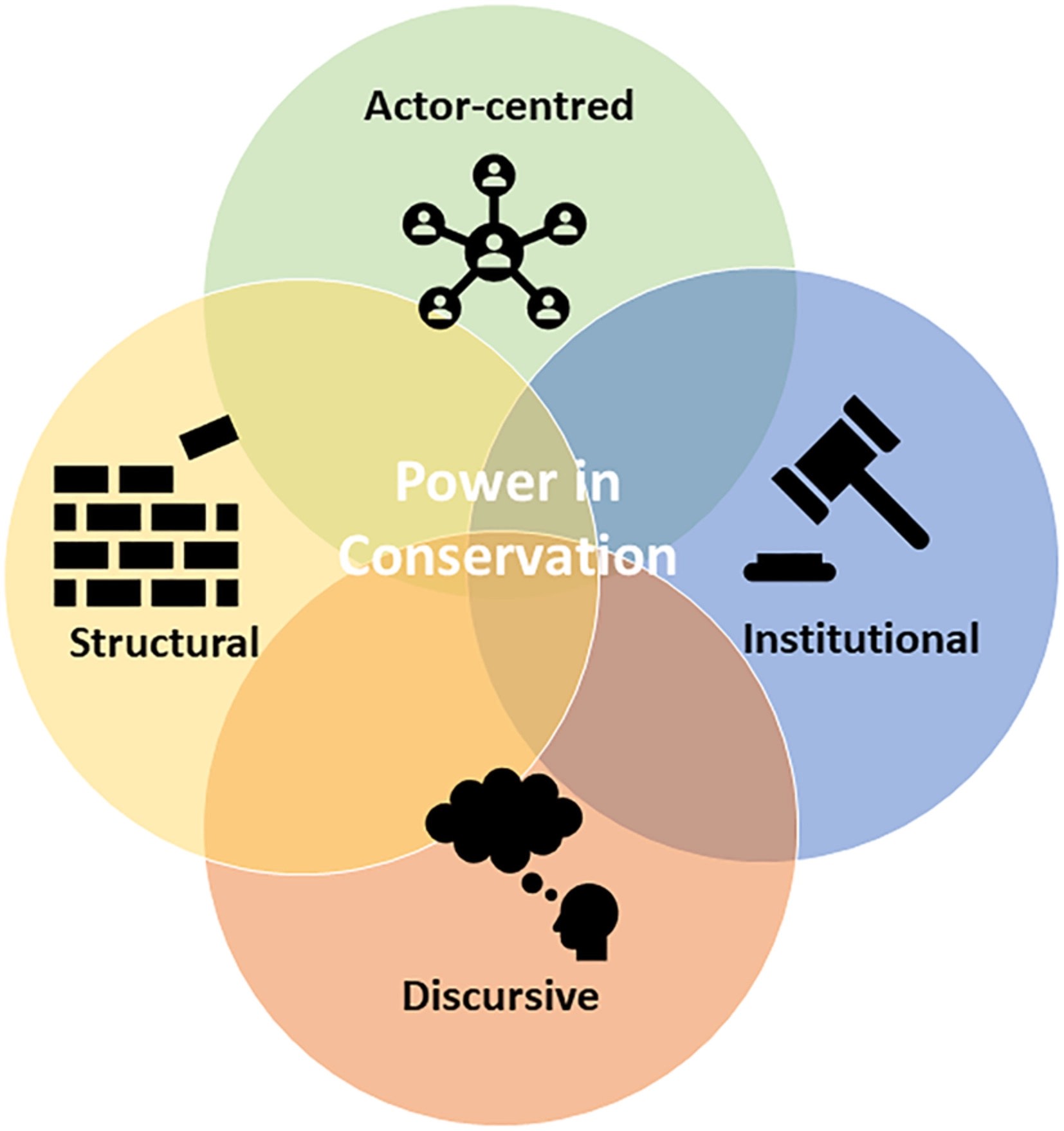
February 8, 2023Power (to decide, implement, resist, inform, convince, …) is needed for good environmental management and nature conservation. It is often contested. Power is also sometimes hard to grasp – it can be held by certain people, by rules, by institutions, by ideas, or even by discourses. This new paper, fruit of a workshop organised by Ross Shackleton here at the University of Lausanne and fruitful exchanges between the co-authors, tries to clarify questions of power and proposes six guiding principles approaching power in conservation research and practice.
Leave a Comment » | Conservation, Political ecology, Uncategorized | Tagged: nature conservation, political ecology, power | Permalink
Posted by christiankull
Webinar on bushfire in Madagascar
December 13, 2022During a recent visit to Antananarivo, I had the privilege of presenting my work on fire to a diverse audience of researchers and policymakers (some around the seminar table, others online). While the presentation largely drew on my now dated work for Isle of Fire, the detailed discussion very much linked it to events in 2022, including terrible forest fires at Ankarafantsika and annual smoke emergencies in the capital.
Thanks to Indri Solutions for initiating and hosting this seminar.
Leave a Comment » | Fire, Madagascar | Tagged: fire ecology, fire management, Madagascar | Permalink
Posted by christiankull
New project: what type of fire regime for what type of benefit (carbon, biodiversity, livelihoods…) in Southern Africa and Madagascar
October 13, 2022
I am happy to announce that we have received funding from SNIS (Swiss Network for International Studies) for a new project. Principal member of the project is fire ecologist and remote sensing specialist Víctor Fernández-García (see also Victor’s blog site), with collaborators at the universities of Antananarivo, Eduardo Mondlane, Swansea, Lausanne, and Léon, and at FAO and SANParks.
Read the rest of this entry »
1 Comment | Conservation, Fire, Madagascar, Research | Tagged: fire regime, Kruger National Park, Madagascar grasslands, remote sensing | Permalink
Posted by christiankull
Madagascar’s fire regimes compared to the rest of the tropics
June 15, 2022Bushfire is often seen as symbolic of environmental catastrophe on Madagascar. But is it? A global comparison of fire regimes based on satellite image data suggests care in jumping to such conclusions. A recent article in Global Change Biology, led by Leanne Phelps and to which I contributed, finds that the island’s fire regimes have analogues to 88% of fire regimes in the global tropics with similar climate and vegetation. Madagascar’s fires, while exceptionally vilified, are not exceptional. It also demonstrates that the large, landscape-scale grassland fires common across highland and western Madagascar have no relationship to forest loss; indeed forest loss occurs in places without large-scale fires.

Leave a Comment » | Fire, Madagascar, Research | Tagged: bushfire, Madagascar, remote sensing | Permalink
Posted by christiankull
What is “political ecology” these days?
May 31, 2022
In a recent doctoral reading group here at the University of Lausanne, we discussed the 1987 text by Blaikie and Brookfield titled Land Degradation and Society, which is often cited as the foundational text for the field of political ecology. Comparing that groundbreaking work with current discussions under the political ecology label shows both continuities and new trends. Continuities include concern over environmental change and a ‘double posture’ of engaging with science on the issue at hand as well as a critical perspective with that science (for instance measuring soil degradation as well as asking what that concept means); concerns with the impacts of capitalism and colonialism; attention to property systems etc etc. Newer trends include the full-blown arrival of various approaches steeped in continental philosophy (poststructuralism, actor networks, assemblages, hegemony, bare life, governmentality….) and in diverse intersectional and decolonial postures. But where is the field now?
Read the rest of this entry »
1 Comment | Political ecology, Research | Tagged: bibliometrics, epistemic communities, lexicometrics, political ecology | Permalink
Posted by christiankull
Acacias (wattles, mimosas) in your landscape: survey
February 2, 2022
Together with Charlie Shackleton, I am updating our 2011 global study of the adoption, use, and perception of non-native Australian acacias in landscapes around the world. We seek to identify changes and trends in the presence of these trees and how they have been welcomed (or not), and used (or not). To that effect, we have prepared a brief online survey.
Read the rest of this entry »
1 Comment | Acacia, Introduced and Invasive Plants, Research | Permalink
Posted by christiankull

 Christian Kull