Oil palm gets all the attention, but what about acacia? Oil palm has become synonymous with deforestation in Indonesia and resulting losses of orang-utan habitat, increased carbon emissions, and unhealthy smoke haze. But equally large areas of peatland are being converted to pulp and paper plantations of tropical salwood wattles like Acacia crassicarpa and A. magnum, trees that now cover many millions of hectares in South East Asia. In Riau province, Sumatra, the two big pulp mills (operated by Asia Pulp and Paper [APP] and Asia Pacific Resources International Ltd [APRIL]) have around 75 and 45 per cent (respectively) of their pulp plantations located on peatland. The ways in which such forestry concessions have been granted and implemented have inspired dramatic protests: 28 residents of the Meranti Islands in Riau Province stitched their lips shut while demonstrating in front of government buildings in Jakarta (Jakarta Post; Transparency Int.). Read the rest of this entry »
Peatland deforestation for acacia in Indonesia
September 27, 2014
 1 Comment |
  Acacia, Conservation, Development, Political ecology, Research, Sustainability | Tagged: deforestation, forestry, Indonesia, peatland, protest |
  Permalink
 Posted by christiankull
Field trip report Madagascar 2014
July 17, 2014I recently returned from my 11th trip to Madagascar in 22 years. My main goal was to scope out potential field sites for an ARC-supported research project entitled “A weed by any other name? Comparing local knowledge and uses of environmental weeds around the Indian Ocean” (with collaborators Priya Rangan, Charlie Shackleton, and Nitin Rai). I took two week-long trips from the capital, first south to my old highland stomping grounds around Antsirabe and Ambositra, and second east to the rice bread-basket of Lake Alaotra, the rainforest escarpment at Andasibe and Beforona, and the coastal plains and hills around Vatomandry. It was also a good opportunity to renew personal and professional connections, including at the University of Antananarivo’s forestry school (ESSA-Forêts), where I was invited to give a presentation. What did I find?
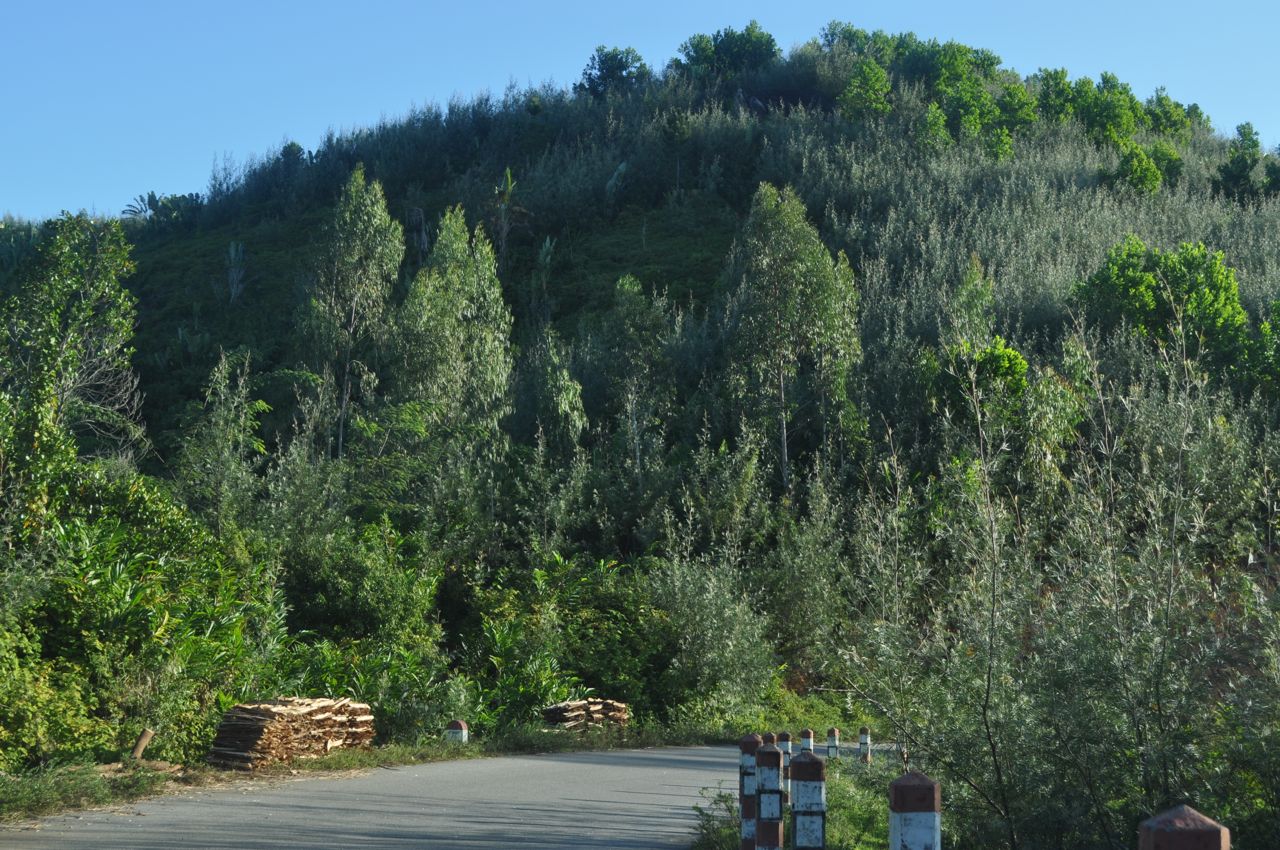
Neo-Australian landscapes along RN11a in eastern Madagascar: Grevillea, Eucalyptus, Acacia…
2 Comments | Acacia, Introduced and Invasive Plants, Madagascar, Research | Permalink
Posted by christiankull
Why we can’t say Madagascar is 90% deforested
April 25, 2014If stated often enough, a fact becomes truth. That seems to be the case with the oft-repeated figure that “Madagascar has lost 90% of its original forest cover”. The problem, as Bill McConnell of Michigan State University and I point out in a letter just published in Science magazine, is that this fact cannot be proven.

Slash-and-burn tavy clearing near Andapa, Madagascar (photo by C. Kull)
5 Comments | Conservation, Madagascar, Political ecology, Research | Tagged: conservation, deforestation, Madagascar, remote sensing | Permalink
Posted by christiankull
Vegetation fire and cultural landscapes in Fiji
March 8, 2014There are three main types of fire in Fiji. Sugar cane farmers burn their fields to facilitate hand harvesting. Village farmers clear forest plots, fallow fields, and secondary vegetation for diverse crops using fire. And finally, the fires that cover the most ground are those set in the grasslands of the drier, lee-side of the islands. And of course there are occasionally fires that cause trouble – late last year I saw a major fire burning through the pine plantations in southeastern Viti Levu.
-
- Sugar cane burns at night south of Nadi, Fiji
-
- Fire scar from grassland fire, southeastern tip of Vanua Levu, Fiji
-
- Uplands in the centre of Viti Levu (Fiji): a pyrocultural landscape
-

- A grassy hill burns at dusk on village land, southeastern tip of Vanua Levu, Fiji
-

- Farmer heading to his fields with fire stick, Tailevu, Viti Levu
-
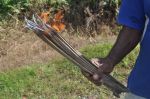
- Close up of fire stick
Leave a Comment » | Fiji, Fire, Research | Tagged: Fiji, fire, fire management, grassland | Permalink
Posted by christiankull
Is everything becoming a ‘Science’? Next up: geographical science, poverty reduction science…
November 25, 2013Is everything becoming a ‘Science’ these days? Land change science, sustainability science, conservation science, invasion science… what is behind all these new labels? This phenomenon seems to have somewhat contradictory drivers: one is an appeal to interdisciplinarity and crossing the natural-social divide; the other is a rhetorical or strategic retreat to the authority of Science-with-a-capital-S. The consequence is a number of approaches claiming intellectual territory and scientific, ‘apolitical’ authority and largely shutting the doors for reflective, interpretive, and critical social science and humanities approaches. Read the rest of this entry »
2 Comments | Research, Sustainability | Tagged: conservation science, sustainability science | Permalink
Posted by christiankull
Competing interdisciplinarities: report from Cerisy
October 11, 2013Every once in a while, it is worth reflecting on concepts that have become so central to discourse that they are repeated ad nauseum but without any novelty. So it goes with ‘interdisciplinarity’, a pet term of any university or research administrator. It is widely desired or required, without much thinking about what it means. For there can be multiple interdisciplinarities, or competing interdisciplinary approaches (as I show for political ecology and resilience, see below). Interdisciplinarity can be a practice, a goal, a tool, or an outcome; it can be individual or team-based; it can be ‘deep’ or ‘shallow’; it can be a spirit of enquiry or a formal requirement.
These were some of the inspirations I gained from attending, this first week of October, an intimate conference on Interdisciplinarités entre natures et sociétés, in Cerisy-la-Salle, France. Read the rest of this entry »
1 Comment | Political ecology, Research | Tagged: conference, disciplinary boundaries, Interdisciplinarity, political ecology | Permalink
Posted by christiankull
Field trip: indigenous perspectives on weeds in the Kimberley
September 25, 2013The team of our current ARC-funded project on local knowledge and uses of environmental weeds recently assembled in Kununurra, far northwest Australia. The project will compare local people’s views of “weeds” across four case studies in four countries around the Indian Ocean – India, South Africa, Madagascar, and Australia. My Monash colleague Priya Rangan and I are collaborating with Charlie Shackleton (Rhodes University, South Africa) and Ramesh Kannan (ATREE, India), supported by Tom Bach (doctoral student on our previous ARC grant) and Pat Lowe (Kimberley-based author and environmentalist). Read the rest of this entry »
1 Comment | Acacia, Conservation, Introduced and Invasive Plants, Political ecology, Research | Tagged: research, weeds | Permalink
Posted by christiankull
Rural development and landscape transformations in highland Madagascar
September 10, 2013How did forty years of rural development, population growth, and conservation action transform the landscapes of highland Madagascar? My recently published [1, 2] analysis of a region-wide sample of air photos from circa 1950 and 1991 document several key trends: crop fields, settlements, and exotic trees are replacing open grassland, while irrigated rice is expanding at the expense of wetland and riparian vegetation.

Farmhouse among the intensively cultivated rice terraces of Betafo, west of Antsirabe
2 Comments | Development, Madagascar, Political ecology, Research, Smallholder farming | Tagged: aerial photography, afforestation, agrarian change, agricultural development, land use change, Madagascar | Permalink
Posted by christiankull
Pyric phases in Madagascar’s longer-than-presumed prehistory
August 7, 2013An exciting archaeological find by Bob Dewar [1] and colleagues suggests the presence of hunter-gatherers on Madagascar around 4000 years ago, which essentially doubles the length of the history of Madagascar’s human settlement. Their discovery, published in PNAS [2], suggests four thousand years of people living, burning, cultivating, shaping, transforming, and developing the island’s environment, instead of around two thousand [3]. From a pyrogeography perspective, Dewar and colleagues make an important point towards the end of their paper: Read the rest of this entry »
1 Comment | Fire, Madagascar, Research | Tagged: archaeology, environmental history, fire, fire regimes, Madagascar, pyrogeography | Permalink
Posted by christiankull
Melting pots of biodiversity
March 20, 2013What happens when you combine human labour, introduced plants, and particular societal histories and structures in a certain tropical landscape? You end up with anthropogenic or cultural landscapes – the “matrix” in current ecological jargon – such as the domesticated forests1 of southeast Asia, the tree gardens of Caribbean or Pacific islands, the shambas of Africa, the rice terraces of Madagascar. Despite their aesthetic and cultural attractions, these smallholder farming landscapes are directly or implicitly critiqued by many – for not being as productive as modern industrial agriculture, for trapping people in rural poverty, and for taking up space at the expense of natural habitats. In two recent papers with French collaborators, I argue instead that such landscapes can be sustainable sources of useful products, can facilitate vibrant and resilient rural communities, and can be resilient contributors to the functioning of local and global biophysical systems.

Leave a Comment » | Conservation, Development, Introduced and Invasive Plants, Research, Smallholder farming, Sustainability | Tagged: agriculture, biodiversity, hotspots, invasive alien species, sustainability, tropics | Permalink
Posted by christiankull

 Christian Kull