Hervé Rakoto and the farmers of highland Madagascar

February 8, 2017

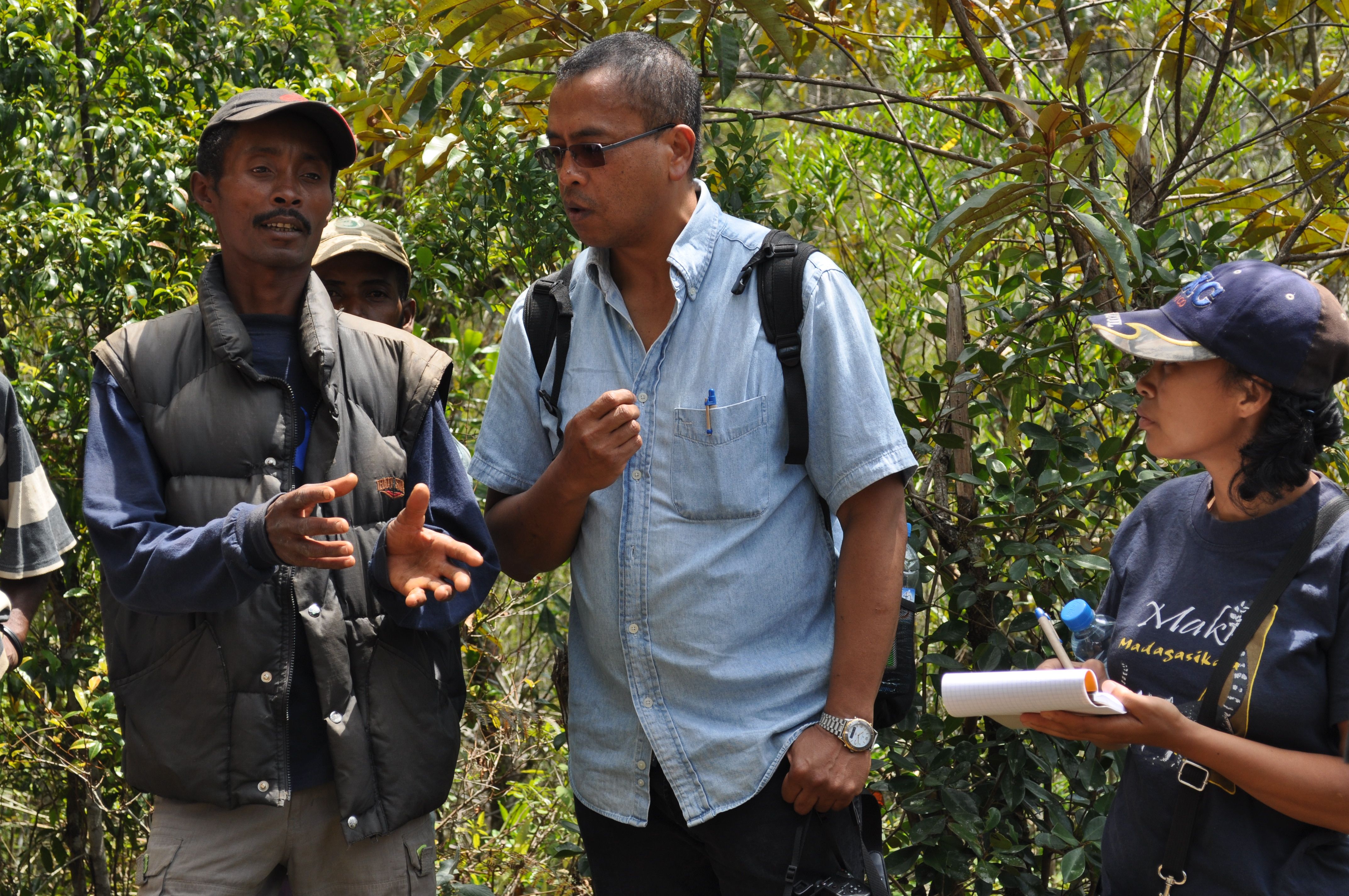
The tantsaha, or farmers, of highland Madagascar lost one of their moHerve in the fieldst empathetic interlocutors in late 2015: the geographer Hervé Rakoto Ramiarantsoa. In his books and articles, Hervé investigated the lives and landscapes of rural Imerina, Betsileo, and Tanala country from the farmer’s perspectives. His wonder and respect for the farmer’s techniques, their intricate reworkings of canals, soils, and paddy fields, was as strong as a farmer’s polished wood angady spade. Read the rest of this entry »


Field studies in the High Atlas

November 29, 2016

We have just inaugurated a new field trip to Morocco with grand success for our masters program*. The idea is to give our masters students experience in “the field” before they head off for their independent fieldwork for their masters thesis. We sought to expose them to the pleasures and challenges of fieldwork that involves linguistic, cultural, and logistical barriers, and build their “soft skills”. To do so, we brought them to a cluster of villages perched on a mountain side in the High Atlas, and – during 4 days of intensive field surveys, interviews, muddy boots, and mint tea – learn what we could about how the villages manage their water, their waste, their cropfields, their pastures, and the touristic potential of the region.

dsc_0369

The villages of Annamer and Aguerd

Read the rest of this entry »


Arbres voyageurs et plantes invasives dans les pays du Sud

October 17, 2016

FGSE Unil ouverture des cours 2016-2017 Last month I gave the ceremonial first lecture of the academic year for our Faculty.  The video is now online (see below).  The presentation dips into a number of research projects I’ve contributed to in recent years in order to make a number of observations about the relationship between plants and people, notably with iconic ‘natural’ plants and problematic ‘invasive’ weeds.  These observations include: Read the rest of this entry »


Share bike commute: only 62% success

July 6, 2016

Geographers have long investigated commuting and transportation. While that isn’t my academic speciality, every commuter in the world probably has some comments and reflections on the “geographies of mobility” (to use current jargon).  Here are my reflections on the city of Lausanne’s shared-bike program, initially sponsored by the two universities EPFL and UNIL.

Read the rest of this entry »


Manifest for an environmental geography (in France)

May 20, 2016

cover of Chartier, D & E Rodary, eds. 2016. Manifeste pour une géographie environnementale. Paris: Les Presses Sciences Po.

In September 2010, fifteen prominent senior French geographers, under the auspices of the Société de Géographie, held a one-day colloquium entitled Le ciel ne va pas nous tomber sur la tête (The sky will not fall on our heads). The participants critiqued the “prevailing obfuscation, radical environmentalism, de-growth, denial of science, and faith in humanity”[1]. While many geographers can sympathise with critiques of simplified or overly catastrophic environmental narratives, as well as with critiques of bad science, this book went much further. It verged on climate change denial and was underlain by the assumption that we need no changes to our lifestyles.[2]  In direct response, two younger geographers named Denis Chartier and Estienne Rodary organized a conference entitled Géographie, Écologie, Politique: un climat de changement at the Université d’Orléans in September 2012 (see my blog entry at the time). Participants in Orléans expressed frustration with what they saw as the dominant school, the old guard. This conference also led to an edited volume, titled Manifeste pour une géographie environnementale, finally published a few months ago – the reason for this blog entry.

Read the rest of this entry »


Notes from a political ecology conference in Stockholm

March 27, 2016

announcement for Entitle conference Undisciplined EnvironmentsI’m on the flight home reflecting on the ENTITLE “Undisciplined Environments” conference, a gathering of 500 (!) people, mostly academics, but also activists and artists, under the banner of political ecology. What is this ‘political ecology’ that brought so many people to Stockholm?  Does it mean the same thing as when Land Degradation and Society was written some 30 years ago, a spirit of disciplinary crossing and plural epistemologies but rooted in a cross fertilization of cultural ecology and Marxist political economy? What I found was an open collective of intellectuals engaged in red-green issues of social justice and environment and keen to use social theory. Read the rest of this entry »


Political ecology and the Anthropocene

January 22, 2016

What does the Anthropocene mean for subsistence farmers Lele or Rakoto?  At first glance, nothing.  It is, after all, just a fashionable term amongst the intelligentsia; the latest jargon to adorn project proposals to do more of the same. But on second thought, for these already marginal farmers, the Anthropocene might concretely mean less rains, stronger cyclones, new weeds: new stresses, challenges, and perhaps opportunities.   Read the rest of this entry »


Living with invasive plants in the Anthropocene

January 6, 2016

What does it mean to live with bioinvasions?  Low-wage labourers donning chemical suits and goggles to spray herbicides in tropical heat? Exurban homeowners cutting back an invasive vine near their back porch, but letting it run wild at the other side of the property? State environmental managers making difficult choices about what weeds to spend money on? In a recent collective paper inspired by the Wollongong Weeds Workshop (Head et al. 2015, see below), we seek to draw attention to the practical, lived side of managing weeds.

Poisoned Acacia nilotica in the Mitchell grasslands, northwest Queensland

Poisoned Acacia nilotica in the Mitchell grasslands, northwest Queensland

The paper is organised around five themes that arise from managers’ reflections on their work. It identifies tensions between the ideals arising out of invasion biology, resulting regulatory and policy frameworks, and practical on-the-ground experience.   Read the rest of this entry »


Farmer livelihood practices and the forest transition in Africa

December 19, 2015

In what situations do the practices of small-scale family farmers lead to increased tree cover, particularly on a continent better known for land degradation and deforestation?  Research on the “forest transition”, a pattern where net deforestation is replaced by a net gain in forest cover, has so far avoided much mention of Africa.  In contrast, it is historically documented in western Europe, eastern North America, east Asia, and seemingly underway in parts of Latin America and Southeast Asia.  This research tends to focus on factors such as economic modernisation, rural abandonment, urbanisation, or even globalisation as driving forces of the forest transition.  Two recent studies I contributed to focus instead on Africa – one in West Africa, one in Madagascar – and on transitions brought about by rural farmers. Read the rest of this entry »


Discipline and mastery: impressions of Swiss school system

November 24, 2015

Parents learn can learn a lot about an education system from the vocabulary their children bring home.  Since our arrival in the canton of Vaud, Switzerland, the results are telling.  The words bouncing around the living room are “test, oublie, revision, bavardage, arrivée tardive, heure de retenue, heure d’arrêt, redoubler…”  These are all words about discipline or performance.  Previously, in very different school systems, the words were more along the lines of “my project, the school concert, assembly, homework“.  What does this show? Read the rest of this entry »