Volatile essences, volatile markets, volatile jobs, volatile identities: ravintsara in Madagascar (PhD of Chanelle Adams)

October 15, 2025
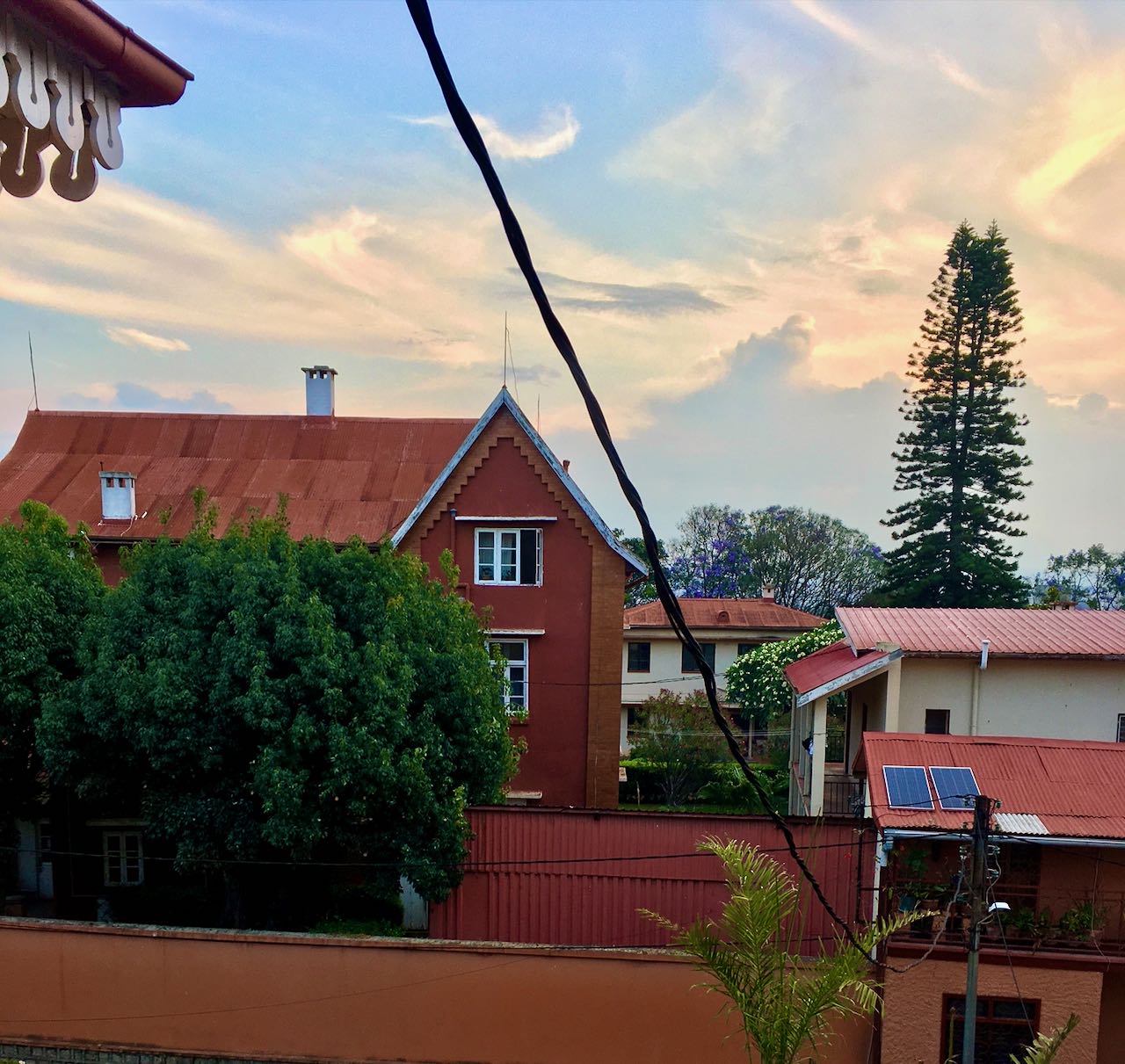
Ornamental ravintsara trees (front left) in Isoraka, Antananarivo, Madagascar (also: jacaranda, aurucaria…). photo: CK 2022.

You know how sometimes a word or thing appears at the margins of your conscience, associated with some value (good, bad, …), but where you really know nothing about it? For me, this describes ravintsara. Long interested in the Malagasy environment, it is perhaps natural that a tree with a name like that would catch my attention (even a beginner in Malagasy will get that it means “good leaf”). While doing research on fire, agrarian change, and highland reforestation, ravintsara crossed my path plenty in the late 1990s and 2000s, but it was never centre stage. I first encountered it knowingly in 2014, when friends showed me some they had planted a few to ornament their land outside Antananarivo, and they were proud to have something native and not pine or eucalyptus. But strangely, its name was already there in a list of 1000s of plants in an inventory of introduced species in Madagascar that colleagues and I put together. And then since moving to Europe I started noticing ravintsara in the essential oils section of French pharmacies.

Chanelle Adam’s PhD, just defended, shows there is history and reason behind my encounters and confusions. It turns out that the botanical and chemical identity of the tree has only been established for three decades or so. Ravintsara was indeed introduced to Madagascar, probably in the 19th century (it is better known elsewhere as the camphor laurel, Camphora officinarum, source of camphor oil). And yet… the variety growing in Madagascar turns out to be a chemotype specific to Madagascar called 1,8-cineole, which is low in camphor oil and high in cineole (also found in eucalypts, rosemary, and bay leaves). To confuse matters further, the endemic tree Cryptocarya agathophylla (also used for essential oils) was previously called ravensara (though not by locals) and confusion between two persists. As environmental programs proliferated on the island in the 1990s and 2000s, the search was on for local trees to reforest the island, and ravensara/ravintsara was a prime candidate (hence my encounter on my friends’ plot in the peripheries of Tana). And with development programs entering the 2000s looking for “win-win” solutions for both environment and livelihoods, essential oil distillation was widely promoted – especially as local distillers and scientists (perhaps benefitting from long-term French investments and know-how in the fragrance, oil, and pharmaceutical arena) had set the groundwork in previous decades, themselves building on and branching from colonial era industries (ylang-ylang, cloves, vanilla…). Hence the little ravintsara bottles in French pharmacies. This all leads up to the opening scene of Chanelle’s thesis, the time when during the height of the Covid 19 crisis the just-deposed President of Madagascar himself claimed to have a cure for the coronavirus – a concoction based in part on ravintsara. And that’s a story that Chanelle tells much better than me!

Read the rest of this entry »

Knowledge gaps and narrative traps in Madagascar’s environmental history

July 1, 2025
Onilahy River, southwest Madagascar

Madagascar’s environmental past is more complex and regionally diverse than the tired narrative of a once-forested island devastated by people would have us believe. In a just-published opinion piece led by one of my academic heroines, Alison Richard, we unpack this oversimplified story, showing how diverse landscapes—from ancient grasslands to dynamic forest mosaics—shifted over millennia, shaped by both natural forces and human action. Yet traces of that older narrative linger stubbornly in scientific debates and conservation strategies. Escaping this narrative trap requires paying closer attention to the deep-time environmental record and to the heterogeneity of human histories across the island.

Read the rest of this entry »

Measuring the extent of Madagascar’s wildfires

January 12, 2024

Two decades ago, in my book on fire in Madagascar published at the University of Chicago Press, I made an educated guess that “in grasslands, roughly one-quarter to one-half of the surface burns annually“. A footnote fills over half of the page to justify my estimate, drawing from local studies, observations, government statistics, and rudimentary satellite data. I am thrilled to report that a just-published study confirms this estimate and makes it more precise, finding that 32% or so of the grasslands burn each year. The study takes advantage of newer satellite images that are more frequent and higher resolution to make its estimates, catching smaller and more ephemeral (quickly regreening) fire patches. Congratulations to Víctor Fernández-García on leading this work, funded by a Swiss Network for International Studies grant.

Fire in the highlands (photo: YK, 2018)
Read the rest of this entry »

Tany malalaka: settling new land in the western highlands of Madagascar

December 9, 2023

Like over a million (!) other viewers, I was captivated by the recent video “What’s inside this crater in Madagascar?” by Christophe Haubursin on Vox. Curiosity, satellite images, internet, a budget for a talented local filmmaker, and excellent production allow the team to explore why a village appears out of nothing fifteen years ago inside a remote broad, circular mountain in central Madagascar. Having spent days and days poring over historical air photos and maps of highland Madagascar for my own research, I palpably felt empathy for Haubursin’s landscape voyeurism. Then imagine my excitement as I realised I’ve been there myself, almost at the village site, on the southern summit of the mountain Ambohiby, in 1999, before it was built!

In this post, I’ll do two things: comment on some photos from my 1999 climb of Ambohiby, and give some leads for people looking to read further on the colonisation of empty lands in highland Madagascar, as I have been researching the settlement of new lands by Betsileo farmers since my masters thesis fieldwork in 1994.

My photo of the view north from Ambohiby summit in July 1999. The new village site Anosibe Ambohiby would be in the burn scar in the middle.
Read the rest of this entry »

Ethnographic fieldwork on farms, fires, and forests in Madagascar

June 27, 2023

I was interviewed by our Faculty’s research consultant on doing research in Madagascar. Here’s the result, with some fun pictures.


Webinar on bushfire in Madagascar

December 13, 2022

During a recent visit to Antananarivo, I had the privilege of presenting my work on fire to a diverse audience of researchers and policymakers (some around the seminar table, others online). While the presentation largely drew on my now dated work for Isle of Fire, the detailed discussion very much linked it to events in 2022, including terrible forest fires at Ankarafantsika and annual smoke emergencies in the capital.

https://fb.watch/rp_QuPLVfY

https://www.facebook.com/plugins/video.php?height=268&href=https%3A%2F%2Fwww.facebook.com%2Fsolutions.indri%2Fvideos%2F878076529888365%2F&show_text=false&width=560&t=0

Thanks to Indri Solutions for initiating and hosting this seminar.


Madagascar’s fire regimes compared to the rest of the tropics

June 15, 2022

Bushfire is often seen as symbolic of environmental catastrophe on Madagascar. But is it? A global comparison of fire regimes based on satellite image data suggests care in jumping to such conclusions. A recent article in Global Change Biology, led by Leanne Phelps and to which I contributed, finds that the island’s fire regimes have analogues to 88% of fire regimes in the global tropics with similar climate and vegetation. Madagascar’s fires, while exceptionally vilified, are not exceptional. It also demonstrates that the large, landscape-scale grassland fires common across highland and western Madagascar have no relationship to forest loss; indeed forest loss occurs in places without large-scale fires.

Figure 3 from Phelps et al. (2022). Colours represent areas with similar fire regimes (clustered based on burnt area, fire size, seasonality, and numbers of fires). Black pixels represent fire regimes not found on Madagascar. Gray pixels are places without landscape-scale fire regimes. Photos: (a) tapia branch and chameleon at Ibity, (b) uncontrolled, peri-urban landscape fire in Ambositra [photo C. Kull, 2019], (c) a forest-savanna boundary in Ambohitantely, (d) ancient biodiverse grasslands on Ibity, (e) landscape fire in an agricultural region near Ambositra, likely for grassland renewal [photo by C. Kull, 1998/9], (f) tree cover on a forest-savanna boundary in Ambohitantely, (g) smallholder land use on Ibity.
Read the rest of this entry »

Voices from the forest – local people and conservation in Madagascar

December 21, 2021

Congratulations to the team from the “Forest4Climate&People” project at ESSA-Forêts (University of Antananarivo) and the School of Natural Sciences (Bangor University) for this fantastic short film. It is both beautifully done and really informative. Wonderful images as well as guitar picking by D’Gary. And most of all, it has a strong and clear message, contained in the subtitle, that advocates “putting local people at the heart of decisions about tropical forest’s contribution to tackling climate change”.

English version embedded above; voici le lien pour la version française: https://youtu.be/X0S0Y1h4NoE


Trees threaten grasslands in Madagascar more than fire

June 10, 2020

Malagasy grasslands are often ignored, or worse, deplored. Biological research concentrates in the forests, many still shrinking despite conservation efforts. Yet research by plant ecologist Cédrique Solofondranohatra adds another layer of argument to the case that Malagasy grasslands have an ancient history and are important reservoirs of biodiversity themselves. Despite this, recent tree-planting efforts for climate change mitigation (of the ‘trillion trees‘ mode) often seem to take the easy path formed by a century of habit: planting exotic pines, acacias, and eucalypts in the grasslands, perceived as open, available, fire-damaged, and worthless. A much more laudable goal would be to restore trees to areas recently deforested.

A new look at Malagasy grasslands: researchers visit Ambohitantely
Read the rest of this entry »

Farmer livelihood practices and the forest transition in Africa

December 19, 2015

In what situations do the practices of small-scale family farmers lead to increased tree cover, particularly on a continent better known for land degradation and deforestation?  Research on the “forest transition”, a pattern where net deforestation is replaced by a net gain in forest cover, has so far avoided much mention of Africa.  In contrast, it is historically documented in western Europe, eastern North America, east Asia, and seemingly underway in parts of Latin America and Southeast Asia.  This research tends to focus on factors such as economic modernisation, rural abandonment, urbanisation, or even globalisation as driving forces of the forest transition.  Two recent studies I contributed to focus instead on Africa – one in West Africa, one in Madagascar – and on transitions brought about by rural farmers. Read the rest of this entry »