 Last month I gave the ceremonial first lecture of the academic year for our Faculty. The video is now online (see below). The presentation dips into a number of research projects I’ve contributed to in recent years in order to make a number of observations about the relationship between plants and people, notably with iconic ‘natural’ plants and problematic ‘invasive’ weeds. These observations include: Read the rest of this entry »
Arbres voyageurs et plantes invasives dans les pays du Sud
October 17, 2016
 Leave a Comment » |
  Acacia, Conservation, Interdisciplinarity, Introduced and Invasive Plants, Sustainability, Uncategorized | Tagged: australian acacias, baobabs, biological invasions, invasive species, weeds |
  Permalink
 Posted by christiankull
Living with invasive plants in the Anthropocene
January 6, 2016What does it mean to live with bioinvasions? Low-wage labourers donning chemical suits and goggles to spray herbicides in tropical heat? Exurban homeowners cutting back an invasive vine near their back porch, but letting it run wild at the other side of the property? State environmental managers making difficult choices about what weeds to spend money on? In a recent collective paper inspired by the Wollongong Weeds Workshop (Head et al. 2015, see below), we seek to draw attention to the practical, lived side of managing weeds.

Poisoned Acacia nilotica in the Mitchell grasslands, northwest Queensland
The paper is organised around five themes that arise from managers’ reflections on their work. It identifies tensions between the ideals arising out of invasion biology, resulting regulatory and policy frameworks, and practical on-the-ground experience. Read the rest of this entry »
Leave a Comment » | Interdisciplinarity, Introduced and Invasive Plants, Political ecology, Research, Sustainability | Permalink
Posted by christiankull
Farmer livelihood practices and the forest transition in Africa
December 19, 2015In what situations do the practices of small-scale family farmers lead to increased tree cover, particularly on a continent better known for land degradation and deforestation? Research on the “forest transition”, a pattern where net deforestation is replaced by a net gain in forest cover, has so far avoided much mention of Africa. In contrast, it is historically documented in western Europe, eastern North America, east Asia, and seemingly underway in parts of Latin America and Southeast Asia. This research tends to focus on factors such as economic modernisation, rural abandonment, urbanisation, or even globalisation as driving forces of the forest transition. Two recent studies I contributed to focus instead on Africa – one in West Africa, one in Madagascar – and on transitions brought about by rural farmers. Read the rest of this entry »
1 Comment | Development, Environmental History, Introduced and Invasive Plants, Research, Smallholder farming, Sustainability | Tagged: afforestation, FMNR (Farmer-managed natural regeneration), forest transition, Ghana, Madagascar, reforestation, woodlots | Permalink
Posted by christiankull
A political ecology of weeds
October 1, 2015How do plants that move and spread across landscapes become branded as weeds and thereby objects of contention and control? In a chapter recently published in the International Handbook of Political Ecology, Priya Rangan and I outline a political ecology approach that builds on a Lefebvrian understanding of the production of space, identifying three scalar moments that make plants into ‘weeds’ in different spatial contexts and landscapes. Read the rest of this entry »
Leave a Comment » | Acacia, Introduced and Invasive Plants, Political ecology, Research | Tagged: invasion biology, landscapes, political ecology, weeds | Permalink
Posted by christiankull
Thorny landscapes
September 26, 2015Just rediscovered a scribbled note from a few days in the “brousse” of New Caledonia late last year. We visited landscapes pounded by grazing, from a 600 ha cattle station turned into a horse farm and gîte in the more wild, mountainous nickel mining country around Thio, to the yellow-grass cattle and goat ranches in the semi-arid rain shadow country of Boulouparis. In these places, I found myself in the company of a variety of familiar thorny and weedy plants like mimosa bush, lantana, and coffee bush. Different bouquets of the same suite of plants decorate pastoral landscapes I’ve encountered in Fiji, Vanuatu, Madagascar, Australia, Reunion… and probably many more places too.

The thorny bush Acacia (Vachellia) farnesiana on a cattle ranch near Boulouparis, New Caledonia
Seeing these ‘old friends’ reminded me of a simple message about biological invasions that does not get enough consideration: it’s not the plant’ fault. The plants themselves – or the plant species – do not really deserve the lables as invasives and weeds. It is us humans that need to be branded: they are there because of us, because of our land uses and Read the rest of this entry »
Leave a Comment » | Acacia, Introduced and Invasive Plants, Political ecology, Research | Permalink
Posted by christiankull
People and the dispersal of baobabs around the Indian Ocean
April 2, 2015The baobab, that iconic, majestic, and grotesquely massive roots-in-the-sky tree, teaches us something surprising about “nature”. It demonstrates that what appears to be “natural” has been – for millennia and millennia – also fundamentally “social”, for people have been important dispersal agents of these trees. Researchers like Chris Duvall and Jean-Michel Leong Pock Tsy have shown this for the African baobabs.[1,2] Our recently completed research project, led by Priya Rangan, demonstrates this in multiple ways around the Indian Ocean. Baobabs are such useful and remarkable trees [3], it is hardly difficult to imagine people not picking up the hard but pleasantly light and fuzzy fruit pods and walking with them.

A young baobab near an Aboriginal rock art site (photo: CKull)
One part of our project looked at the single species of baobabs found in Australia: Adansonia gregorii, called boab. It grows in the Kimberley region in the northwestern part of the continent. In a study just published in PLoS ONE [4], we combine evidence from baobab genetics [5] and Australian Aboriginal languages to show that humans have been the primary agents of baobab dispersal. In particular, we reveal their crucial role in dispersing baobabs inland from now-submerged areas of northwest Australia during the dramatic sea-level rises at the end of the last glaciation. (See also this article in The Conversation as well as Priya’s blog about the study)
A further question is how the baobabs arrived in Australia in the first place. Oceanic dispersal via seed pods floating in currents, several million years ago, remains the most plausible explanation, as our collaborator David Baum has shown [6]. Yet, another one of our baobab collaborators (and veritable Renaissance man) Jack Pettigrew advances an interesting speculative argument about a possible human role in transporting the baobabs, building on evidence from rock art in the Kimberley and in Read the rest of this entry »
5 Comments | Environmental History, Introduced and Invasive Plants, Research | Tagged: Australia, baobab, dispersal, historical biogeography, Indian Ocean, Kimberley | Permalink
Posted by christiankull
Approaching invasive species in Madagascar
March 13, 2015While a number of plants, animals, and insects in Madagascar have been called ’invasive’, the topic of invasive species has until recently received less attention here than in other island contexts. Some species, often alien to Madagascar and introduced by humans, have expanded their range rapidly and have had both negative and positive effects on landscapes, on native biodiversity, and on livelihoods. Examples include the prickly pear (raketa), the silver wattle (mimosa), and, recently, the Asian common toad (radaka boka). Building on a conceptual approach, my recent paper (link; pdf) in the journal Madagascar Conservation and Development emphasizes the importance of inclusive and deliberative site- and population- specific management of invasive species. The paper analyses three separate concepts commonly used in definitions of invasion: the origin, behaviour, and effects of particular species.
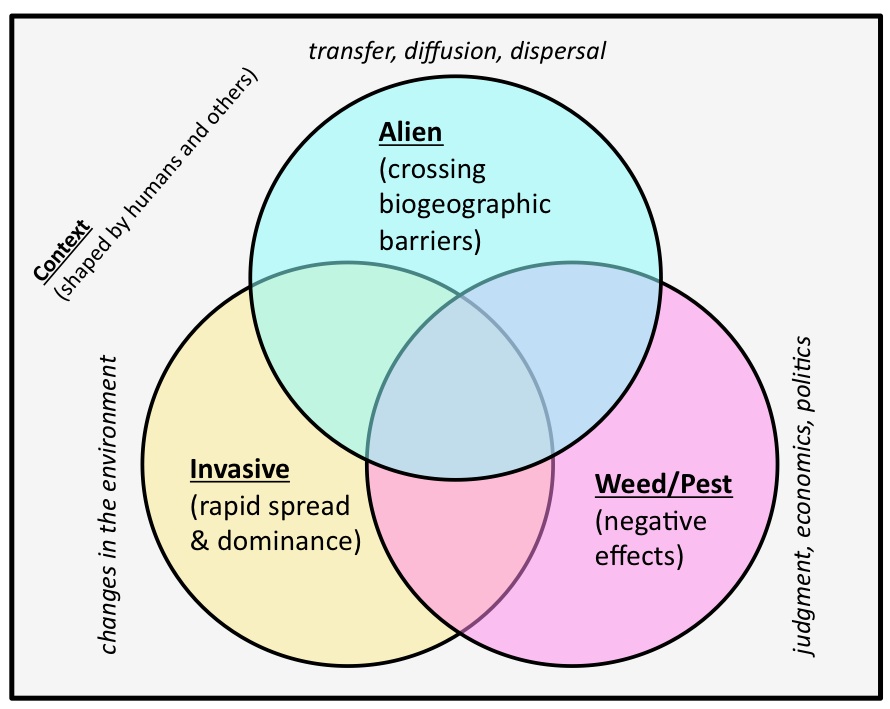
The three components often used in defining invasive species. Different definitions emphasise different components. Source: Kull et al. 2014 (supplementary online material)
It places these concepts in their broader social and ecological context, with particular attention to local perspectives on invasive species. My co-authors and I illustrate these concepts with numerous Malagasy examples from the literature and our own experiences. Read the rest of this entry »
3 Comments | Introduced and Invasive Plants, Madagascar, Research | Tagged: biological invasions, invasive species, Madagascar | Permalink
Posted by christiankull
Transplants: telling stories of humans through plant movements (blog launch)
October 29, 2014
Just launched: a new website called Trans-Plants that asks “what can we learn about humans through plant movements, weeds, and invasive aliens?” It is a joint venture between Priya Rangan, Christian Kull, and their collaborators on three ARC-funded research projects and on all the activities that have spun-off from there.
Leave a Comment » | Introduced and Invasive Plants, Research | Permalink
Posted by christiankull
Lantana, people, and wildlife in southern India (field trip report)
October 6, 2014
A lantana-lined path in the BRT Hills
The thorny bush Lantana camara, with its attractive pink, yellow, and orange flowerlets, covers vast areas of forest understory, fallow lands, and hedges in the hilly mountains fringing the southern end of Karnataka state, India. These upland areas are also home to several marginalized cultural groups (‘scheduled tribes’, or ‘indigenous people’) as well as a diversity of wildlife – elephants, tigers, bears, gaur, three kinds of deer, monkeys, boars, wild dogs, leopards. On our recent scoping trip to the Biligiri Ranganaswamy Hills some four hour south of Bangalore, we discovered that there were at least three ways one could talk about the lantana situation, each following familiar tropes: as a story of invasion, of dispossession, or of creative redemption. Read the rest of this entry »
Leave a Comment » | Development, Fire, Introduced and Invasive Plants, Political ecology, Research | Tagged: India, lantana, protected area | Permalink
Posted by christiankull
Reflections on invasion biology
September 9, 2014Invasion biology has been a remarkably active branch of the life sciences in the past two decades. My itinerary first crossed this field when I noticed, at the time of my move to Melbourne, that the ‘precious’ mimosas (acacias, wattles) of the Madagascar highlands were called ‘green cancer’ in South Africa, and in both cases were introduced from Australia. It was quite surprising to discover that this shrubby tree, so appreciated by Malagasy farmers (as a resource) and environmental managers (as ‘regreening’ barren lands), was seen so negatively across the Mozambique Channel. This observation led to a research program that (1) opened a window for me to learn about and consider the field of invasion biology, and (2), serendipitously, to collaboration with ecologist Jacques Tassin at the French research institute Cirad. I comment on some of the recent fruits of both in this blog.

- The South African approach to alien plants. Cartoon from environmental education material collected in 2006 (thanks to Rémy Kinna).

In a just-published viewpoint in the journal Land Use Policy [free official pdf until Oct. 6; pdf; link], Jacques and I argue that Read the rest of this entry »
2 Comments | Acacia, Book Review, Introduced and Invasive Plants | Tagged: biological invasions, invasive species | Permalink
Posted by christiankull

 Christian Kull