The last two years have been unpleasant for geography and environmental science at Monash. What was once a thriving School of Geography and Environmental Science has been wilfully destroyed, reduced to a “Centre” soon to have only four permanent staff. Excellent and committed as these colleagues are, they have been marginalised and will struggle to return GES to its glory days unless the university reinvests in genuine interdisciplinary teaching and research at the nature-society interface. Read the rest of this entry »
The rise and fall of geography and environmental science at Monash University
November 28, 2014
 1 Comment |
  Interdisciplinarity, Teaching | Tagged: Monash University |
  Permalink
 Posted by christiankull
Transplants: telling stories of humans through plant movements (blog launch)
October 29, 2014
Just launched: a new website called Trans-Plants that asks “what can we learn about humans through plant movements, weeds, and invasive aliens?” It is a joint venture between Priya Rangan, Christian Kull, and their collaborators on three ARC-funded research projects and on all the activities that have spun-off from there.
Leave a Comment » | Introduced and Invasive Plants, Research | Permalink
Posted by christiankull
PhD scholarships in political ecology
October 8, 2014I am recruiting for two doctoral students to work with me in the development studies group at the Institute of Geography and Sustainability at the Université de Lausanne next year. Read the rest of this entry »
1 Comment | Doctoral students, Political ecology | Tagged: bourse d'étude, doctoral studies, political ecology, research assistantship, scholarship | Permalink
Posted by christiankull
Lantana, people, and wildlife in southern India (field trip report)
October 6, 2014
A lantana-lined path in the BRT Hills
The thorny bush Lantana camara, with its attractive pink, yellow, and orange flowerlets, covers vast areas of forest understory, fallow lands, and hedges in the hilly mountains fringing the southern end of Karnataka state, India. These upland areas are also home to several marginalized cultural groups (‘scheduled tribes’, or ‘indigenous people’) as well as a diversity of wildlife – elephants, tigers, bears, gaur, three kinds of deer, monkeys, boars, wild dogs, leopards. On our recent scoping trip to the Biligiri Ranganaswamy Hills some four hour south of Bangalore, we discovered that there were at least three ways one could talk about the lantana situation, each following familiar tropes: as a story of invasion, of dispossession, or of creative redemption. Read the rest of this entry »
Leave a Comment » | Development, Fire, Introduced and Invasive Plants, Political ecology, Research | Tagged: India, lantana, protected area | Permalink
Posted by christiankull
Peatland deforestation for acacia in Indonesia
September 27, 2014Oil palm gets all the attention, but what about acacia? Oil palm has become synonymous with deforestation in Indonesia and resulting losses of orang-utan habitat, increased carbon emissions, and unhealthy smoke haze. But equally large areas of peatland are being converted to pulp and paper plantations of tropical salwood wattles like Acacia crassicarpa and A. magnum, trees that now cover many millions of hectares in South East Asia. In Riau province, Sumatra, the two big pulp mills (operated by Asia Pulp and Paper [APP] and Asia Pacific Resources International Ltd [APRIL]) have around 75 and 45 per cent (respectively) of their pulp plantations located on peatland. The ways in which such forestry concessions have been granted and implemented have inspired dramatic protests: 28 residents of the Meranti Islands in Riau Province stitched their lips shut while demonstrating in front of government buildings in Jakarta (Jakarta Post; Transparency Int.). Read the rest of this entry »
1 Comment | Acacia, Conservation, Development, Political ecology, Research, Sustainability | Tagged: deforestation, forestry, Indonesia, peatland, protest | Permalink
Posted by christiankull
Hello Lausanne!
September 22, 2014I’m very excited to announce that in January 2015 I will be taking up a position as Professeur ordinaire at the Université de Lausanne, or “Unil”, on the shores of Lake Geneva, in Switzerland. Read the rest of this entry »
5 Comments | Teaching | Tagged: Université de Lausanne | Permalink
Posted by christiankull
Reflections on invasion biology
September 9, 2014Invasion biology has been a remarkably active branch of the life sciences in the past two decades. My itinerary first crossed this field when I noticed, at the time of my move to Melbourne, that the ‘precious’ mimosas (acacias, wattles) of the Madagascar highlands were called ‘green cancer’ in South Africa, and in both cases were introduced from Australia. It was quite surprising to discover that this shrubby tree, so appreciated by Malagasy farmers (as a resource) and environmental managers (as ‘regreening’ barren lands), was seen so negatively across the Mozambique Channel. This observation led to a research program that (1) opened a window for me to learn about and consider the field of invasion biology, and (2), serendipitously, to collaboration with ecologist Jacques Tassin at the French research institute Cirad. I comment on some of the recent fruits of both in this blog.

- The South African approach to alien plants. Cartoon from environmental education material collected in 2006 (thanks to Rémy Kinna).

In a just-published viewpoint in the journal Land Use Policy [free official pdf until Oct. 6; pdf; link], Jacques and I argue that Read the rest of this entry »
2 Comments | Acacia, Book Review, Introduced and Invasive Plants | Tagged: biological invasions, invasive species | Permalink
Posted by christiankull
Field trip report Madagascar 2014
July 17, 2014I recently returned from my 11th trip to Madagascar in 22 years. My main goal was to scope out potential field sites for an ARC-supported research project entitled “A weed by any other name? Comparing local knowledge and uses of environmental weeds around the Indian Ocean” (with collaborators Priya Rangan, Charlie Shackleton, and Nitin Rai). I took two week-long trips from the capital, first south to my old highland stomping grounds around Antsirabe and Ambositra, and second east to the rice bread-basket of Lake Alaotra, the rainforest escarpment at Andasibe and Beforona, and the coastal plains and hills around Vatomandry. It was also a good opportunity to renew personal and professional connections, including at the University of Antananarivo’s forestry school (ESSA-Forêts), where I was invited to give a presentation. What did I find?
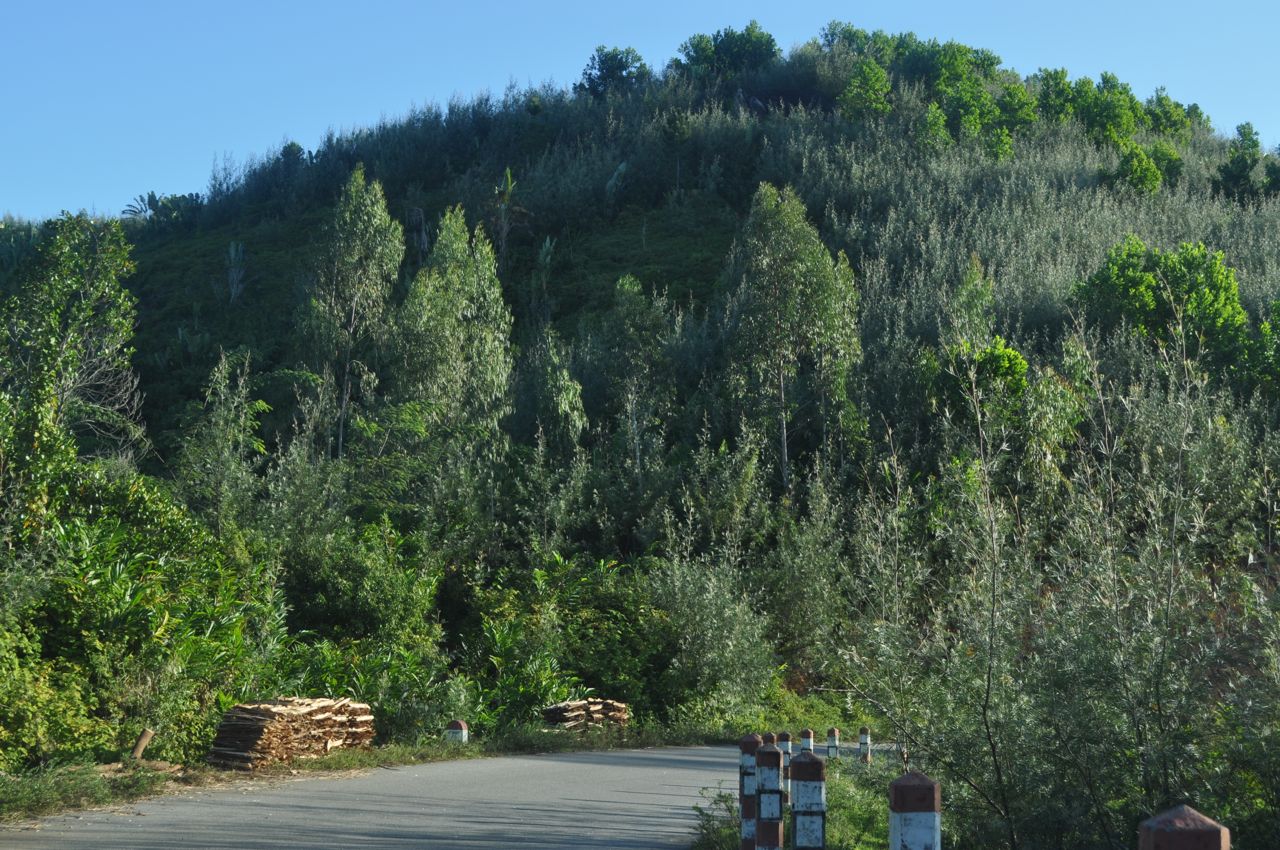
Neo-Australian landscapes along RN11a in eastern Madagascar: Grevillea, Eucalyptus, Acacia…
2 Comments | Acacia, Introduced and Invasive Plants, Madagascar, Research | Permalink
Posted by christiankull
Biodiversity conservation in a developing country: new book
May 9, 2014I’ve finally received my copy of the new edited book Conservation and Environmental Management in Madagascar, edited by Ivan Scales of Cambridge University. This will be a fantastic resource for scholars of Madagascar new and old, as well as more broadly. It includes chapters on a full array of topics: on biodiversity, palaeoecology, and archaeology, on the measurement and causes of deforestation, on environmental politics, policies, programs, and projects, and on different economic development-and-conservation solutions, often (but not always) from a political ecology perspective, broadly construed.

Highlights for me in the book – which also has two of my own chapters – include: Read the rest of this entry »
Leave a Comment » | Book Review, Conservation, Development, Madagascar, Political ecology | Tagged: Madagascar | Permalink
Posted by christiankull
Why we can’t say Madagascar is 90% deforested
April 25, 2014If stated often enough, a fact becomes truth. That seems to be the case with the oft-repeated figure that “Madagascar has lost 90% of its original forest cover”. The problem, as Bill McConnell of Michigan State University and I point out in a letter just published in Science magazine, is that this fact cannot be proven.

Slash-and-burn tavy clearing near Andapa, Madagascar (photo by C. Kull)
5 Comments | Conservation, Madagascar, Political ecology, Research | Tagged: conservation, deforestation, Madagascar, remote sensing | Permalink
Posted by christiankull

 Christian Kull